Geometry & boundaries
What is being assessed?
Drawings, CAD, dimensions, supports, interfaces, known constraints and relevant simplifications.
Services
High-fidelity finite element modelling for components, assemblies, supports, connections and structures where simplified checks cannot represent the governing nonlinear response.
Buyer problem
Global design checks can miss the behaviour that actually controls a decision: contact separation, plasticity, local instability, large deformation, thermal stress, connection flexibility, or complex load transfer through an assembly.
Typical inputs
Drawings, CAD, dimensions, supports, interfaces, known constraints and relevant simplifications.
Material grade/data, preload or operating state, load history, pressure, temperature, impact/blast scenario or other relevant actions.
Local demand, failure mechanism, comparison, screening, residual response, retrofit effect, integrity concern or report requirement.
Technical depth
Use this service when a component or assembly is governed by local behaviour that routine global checks cannot resolve: contact, local plasticity, support flexibility, local buckling, nonlinear load transfer, thermal stress, instability or damage.
Models may use implicit or explicit solution strategies depending on the physics and stability of the problem. Current public work includes Abaqus/Standard and Abaqus/Explicit implementations, but the service itself is solver-independent.
Units, boundary conditions, reaction paths, contact behaviour, mesh density, convergence/stability, energy response and history outputs are checked before conclusions are drawn.
Clients gain a clear explanation of the controlling regions, credible comparison of alternatives, and a documented numerical basis that another engineer can review.
Related evidence
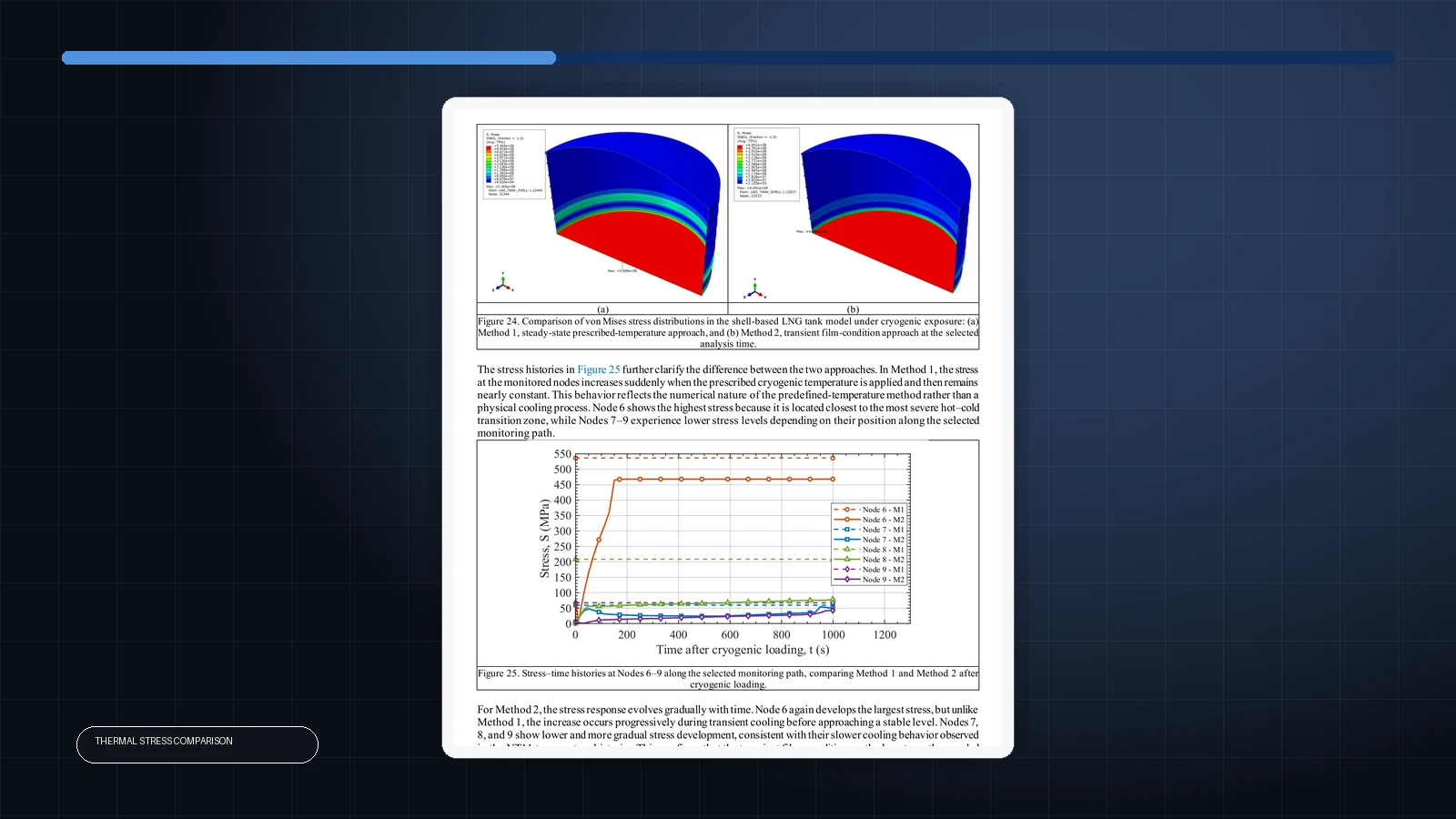
Transient thermal–structural assessment of cooling history, thermal gradients, restraint and stress localization.
Read case study →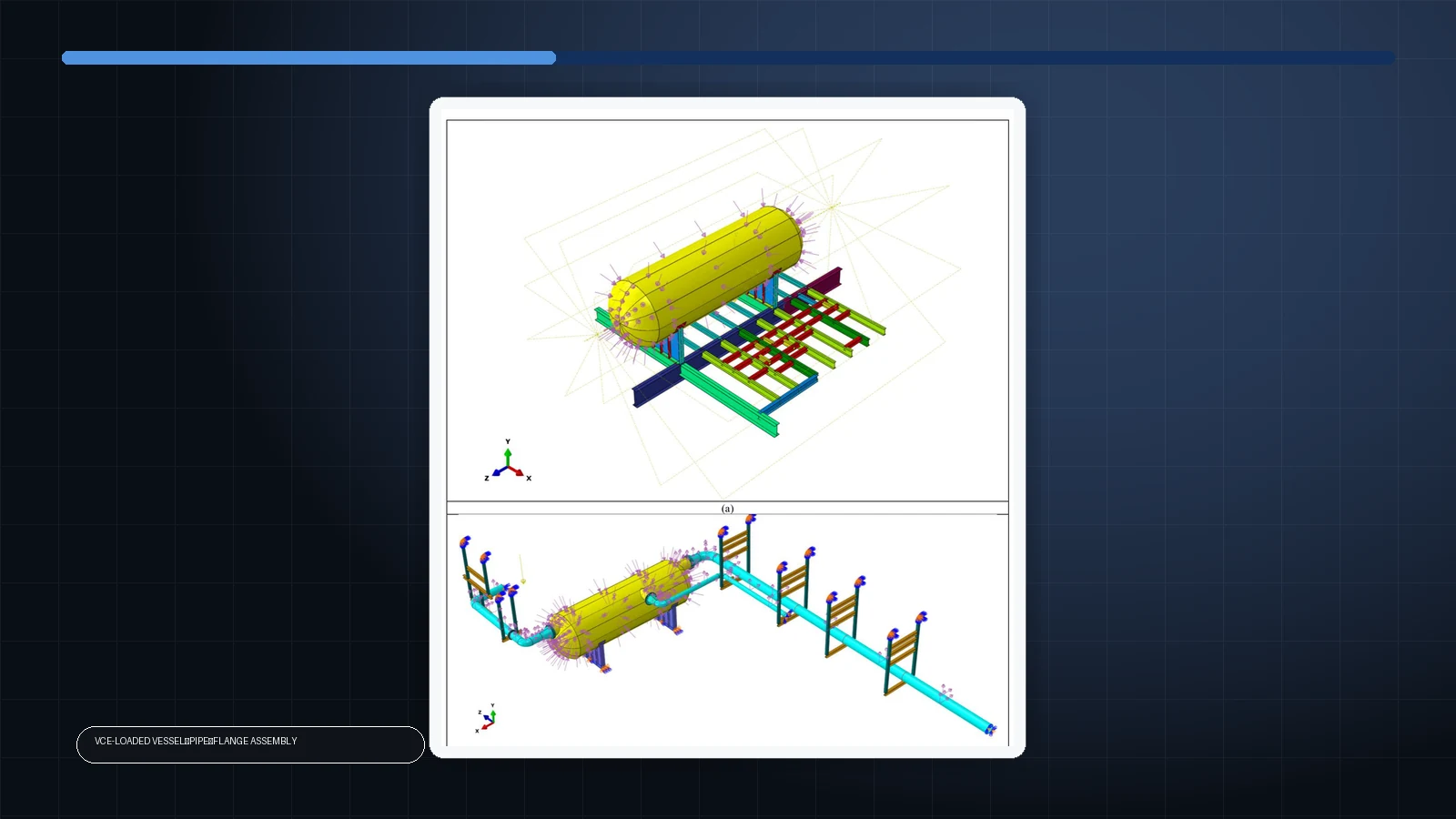
Explosion-driven local deformation and vulnerability in a connected vessel, piping, flange and support system.
Read case study →Send the available information and the engineering question. Axis will propose a suitable analysis route and required inputs.