Case Studies

CFRP-strengthened masonry arch bridge under close-range blast

Peer-reviewed research case demonstrating Abaqus/Explicit CEL blast modelling, detailed masonry bridge representation, CFRP strengthening comparison and advanced material models for blast-resilience assessment.

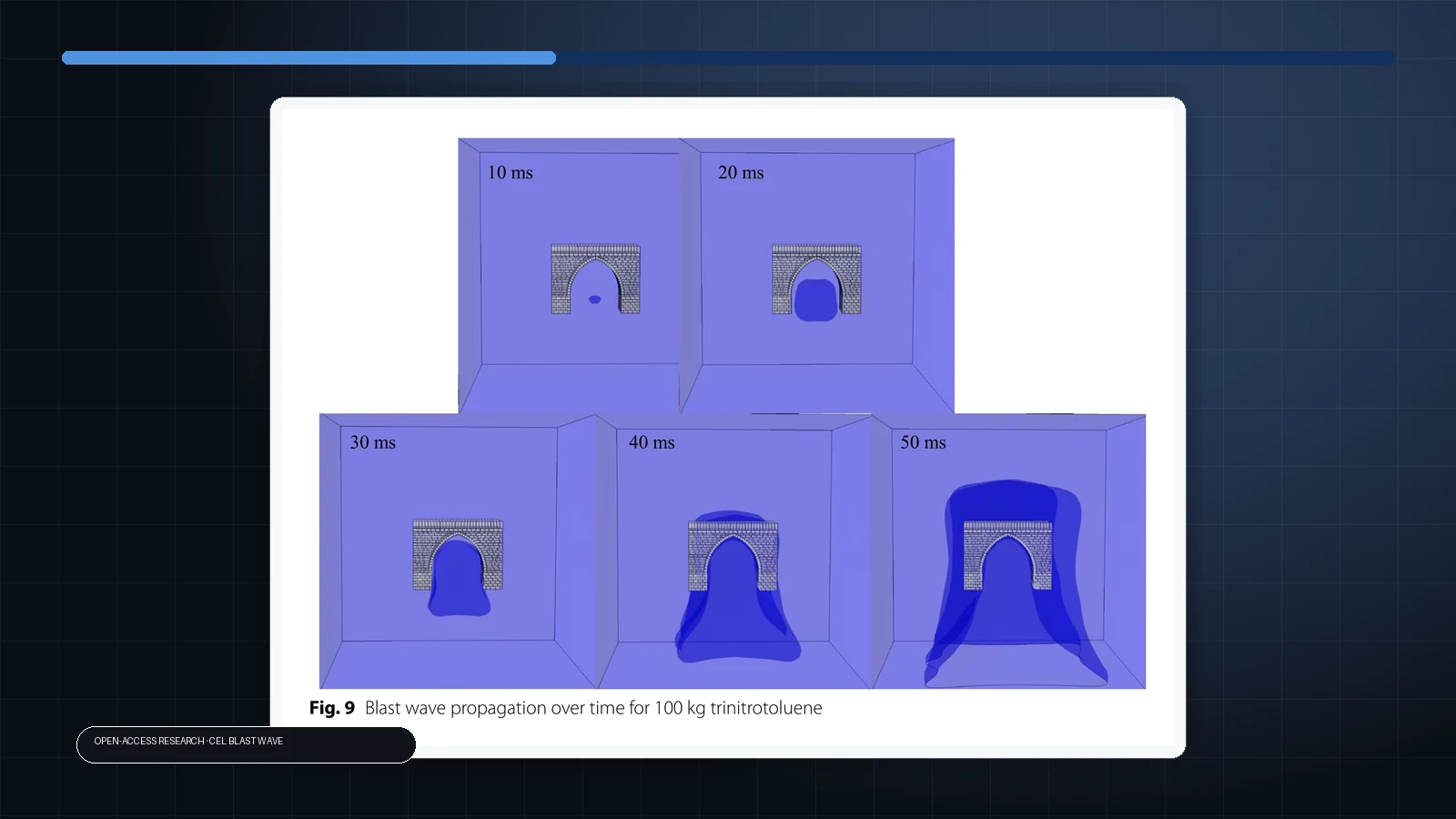
CFRP-strengthened masonry arch bridge under close-range blast main figure
Peer-reviewed research case — figure prepared for website preview.
Status
Peer-reviewed research case
Methods
Abaqus/Explicit · CEL blast simulation · CFRP strengthening · JH-II · Mohr–Coulomb · JWL EOS · VUMAT
Reference
Azar & Sari, Advances in Bridge Engineering, 2024, DOI: 10.1186/s43251-024-00139-z
01

Engineering problem

Masonry arch bridges are vulnerable to impulsive loading because their response can be controlled by local cracking, spalling, arch damage, support interaction, and brittle failure mechanisms that are not represented by simplified static checks.

02

Modelling approach

The research used Abaqus/Explicit with coupled Eulerian–Lagrangian blast modelling, FARO laser scanning geometry, detailed bridge micro-modelling, JH-II damage modelling for masonry units, Mohr–Coulomb backfill representation, JWL equation of state for TNT, and VUMAT implementation for the JH-II model.

03

Outputs assessed

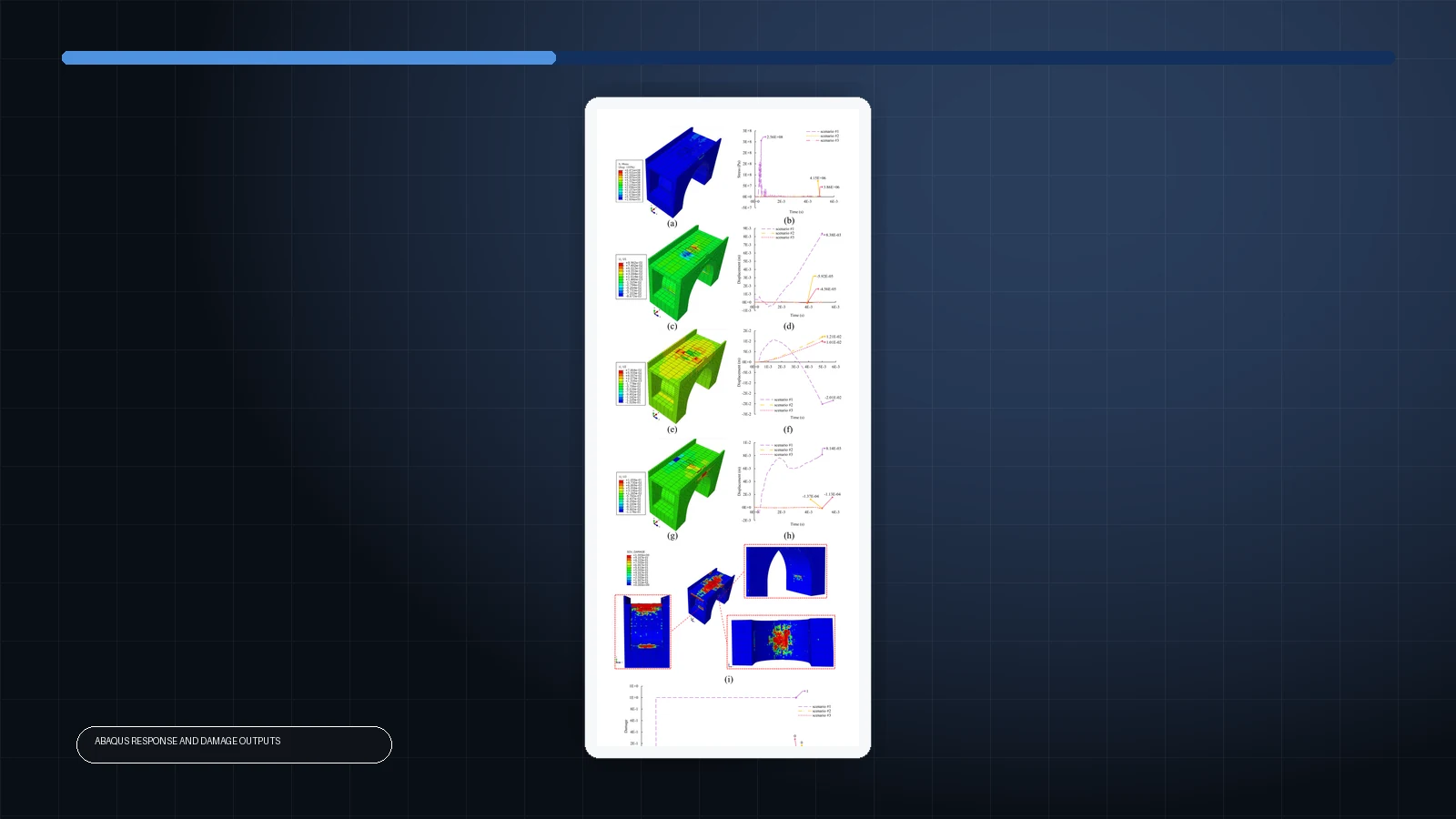
Damage propagation, displacement response, blast wave interaction, critical scenario identification, and comparison of bridge response before and after CFRP strengthening were evaluated.

04

What it demonstrates

For clients, this case demonstrates the ability to model extreme dynamic loading, complex masonry behavior, retrofit concepts, and damage-mechanism interpretation using advanced Abaqus workflows.

Case-study depth

What this case demonstrates.

01

Engineering problem

Masonry arch bridges may fail through local cracking, spalling, arch-ring damage, backfill interaction and support-zone vulnerability under close-range blast. The engineering question is not only whether the bridge collapses, but how damage initiates, where it propagates and whether a retrofit strategy changes the failure mechanism.
02

Abaqus approach

The published research used Abaqus/Explicit with coupled Eulerian–Lagrangian blast modelling. Geometry was supported by FARO laser scanning; masonry units were represented through a Johnson–Holmquist II damage formulation; the backfill used Mohr–Coulomb behaviour; TNT was represented with a Jones–Wilkins–Lee equation of state; and a VUMAT implementation supported the material model workflow.

03

Outputs assessed

The case assessed blast-induced damage propagation, displacement response, location-dependent vulnerability and the effect of CFRP strengthening. It demonstrates how simulation can compare baseline and retrofitted configurations before physical intervention is selected.

04

Client relevance

For Axis clients, this case is a proof of modelling depth: dynamic analysis, complex material behaviour, blast–structure interaction and retrofit comparison. It is not presented as a universal bridge template; every commercial bridge, retrofit or blast problem still needs project-specific scoping, data review and verification.

Professional caveat

The case is a peer-reviewed research example. Use in client work would require project-specific geometry, material data, load definition, acceptance criteria and verification checks.

Technical interpretation

How this informs client work.

This case is used on the Axis website as evidence of modelling depth, not as a universal template. Similar client work would be scoped around project-specific geometry, data availability, material calibration, load definition, reporting needs and verification requirements.

Abaqus/ExplicitCEL blast simulationCFRP strengtheningJH-IIMohr–CoulombJWL EOSVUMAT
CFRP-strengthened masonry arch bridge under close-range blast secondary figure
Secondary visual selected from prepared case-study assets.
Limitations and caveat. This is a peer-reviewed research case, not a claim of completed commercial bridge-retrofit design. Project-specific retrofit decisions require responsible engineering review, site data, and applicable design/approval procedures.

Need a similar technical assessment?

Send the engineering question, available data and expected deliverable level for scoping.

Request scoping review →