01 · Engineering consultancies
When routine design workflows reach their limit.
Independent nonlinear, dynamic, thermal, contact, damage, and local-detail assessment for engineering offices that need specialist finite-element capability on demand.
Advanced finite element simulation · Extreme loads · Structural integrity
From complex physics to defensible engineering decisions.
Axis Advanced Engineering supports engineering consultancies, industrial and EPC teams, asset owners, and R&D organizations with nonlinear finite element simulation, extreme-load assessment, structural-integrity analysis, thermal and cryogenic simulation, and technical reporting built for review.
Who we support
Axis is designed as an external technical partner — not a general design office and not a software-training brand.
Independent nonlinear, dynamic, thermal, contact, damage, and local-detail assessment for engineering offices that need specialist finite-element capability on demand.
Simulation-based assessment for tanks, vessels, supports, piping-related components, offshore systems, blast/VCE exposure, thermal loading, and structural-integrity decisions.
Advanced modelling, custom constitutive behaviour, parametric studies, model verification, post-processing, and technical documentation for demanding R&D programs.
Problems we solve
Resolve local stress, strain, damage, instability, contact, or fracture-driving regions that global checks can miss.
Assess supports, connections, discontinuities, interfaces, local components, and assemblies under realistic nonlinear behaviour.
Translate an impulsive load scenario into deformation, damage progression, vulnerable regions, and practical engineering consequences.
Compare baseline and retrofit configurations using consistent assumptions, response metrics, and clearly defined performance criteria.
Model transient or coupled thermal loading where temperature history, local cooling, and restraint drive structural demand.
Build a traceable chain from assumptions and verification through results, limitations, and final engineering interpretation.
Core capabilities
Contact, plasticity, large deformation, local buckling, instability, damage, assemblies, and complex load transfer.
Explore capability →Impulsive loading, pressure-wave response, structural vulnerability, damage progression, and strengthening comparison.
Explore capability →Tanks, vessels, supports, piping-related components, local discontinuities, offshore systems, and integrity-critical details.
Explore capability →Transient heat transfer, thermal shock, thermal stress, cryogenic exposure, mapped fields, and thermo-mechanical response.
Explore capability →Masonry and bridge systems, retrofit concepts, CFRP, blast/impact vulnerability, local damage, and resilience assessment.
Explore capability →Independent model review, verification, parametric studies, post-processing, technical figures, and defensible reporting.
Explore capability →Why Axis
The solver, element formulation, constitutive model, contact strategy, and level of fidelity are selected around the governing physics and required decision.
Units, load paths, boundary conditions, mesh quality, solver behaviour, energy response, and sensitivity are reviewed before results are treated as evidence.
Specialist simulation execution is supported by senior technical advisory spanning structural engineering, blast, offshore systems, and integrity assessment.
Assumptions, modelling choices, limitations, critical response, and engineering meaning are documented — not hidden behind contour plots.
Selected engineering studies
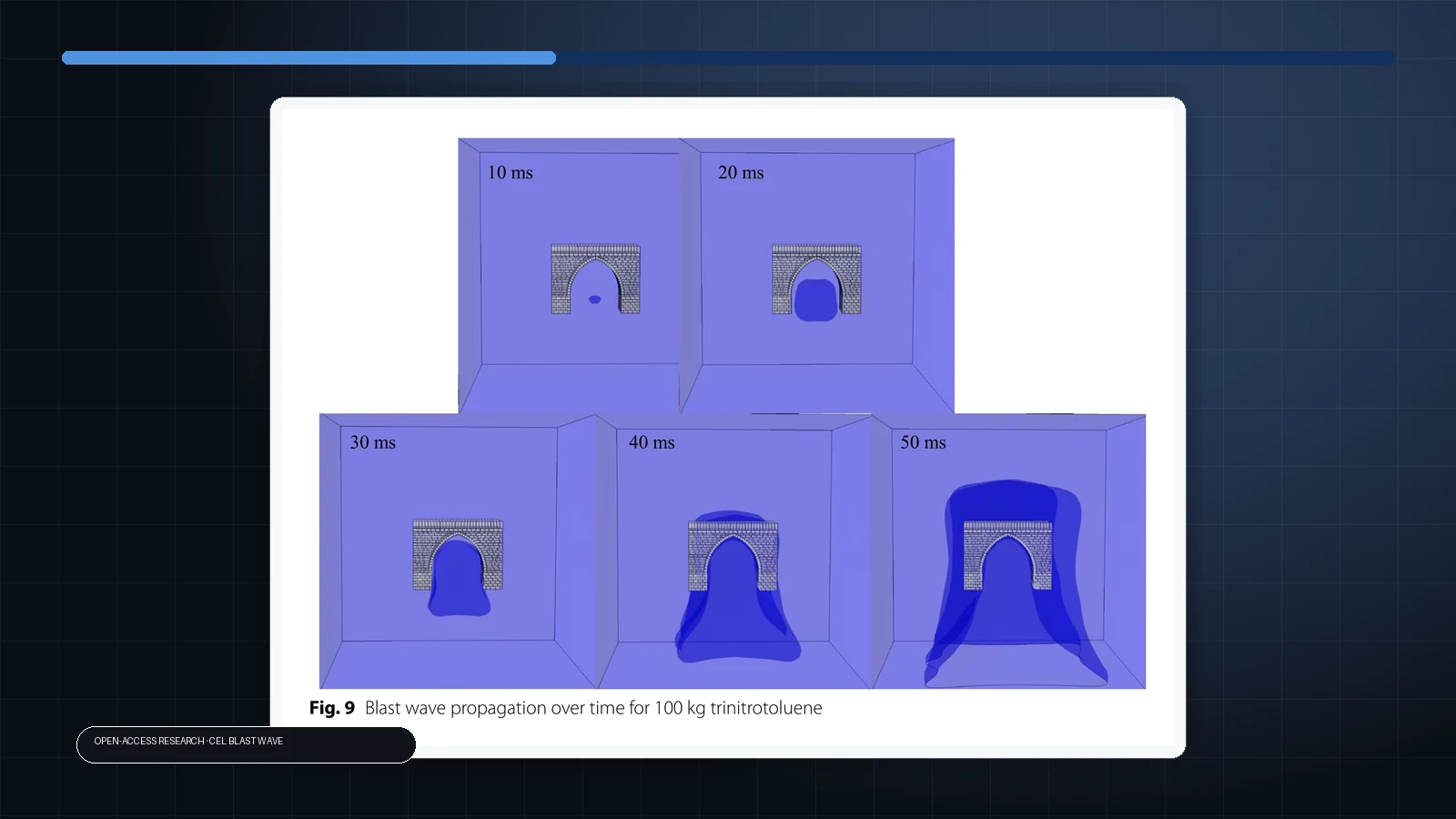
Coupled blast-response modelling used to compare structural damage and strengthening performance under severe impulsive loading.
View engineering case →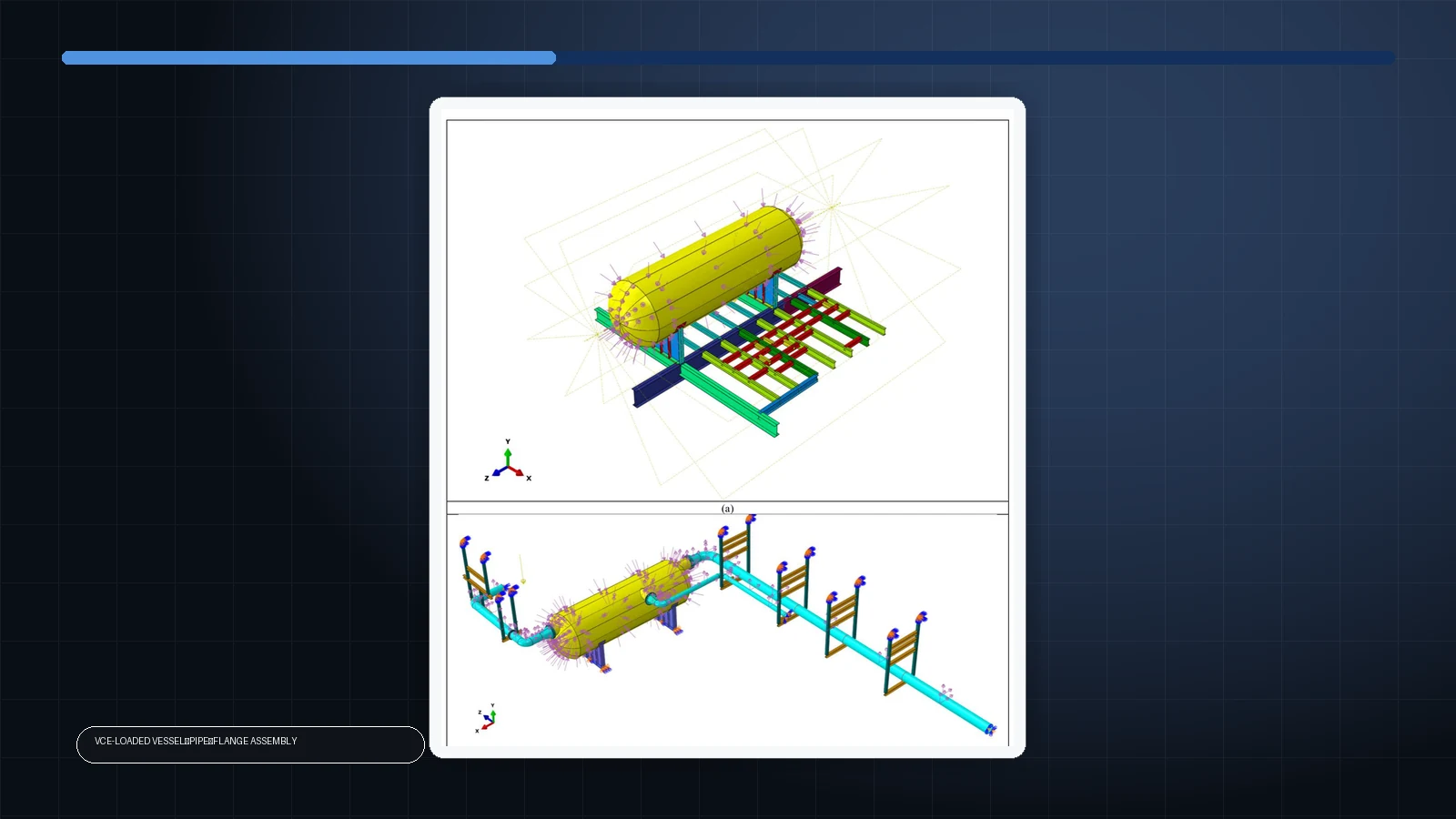
Nonlinear assessment linking explosion-driven local deformation to vulnerable locations in a connected industrial vessel, piping, flange, and support system.
View engineering case →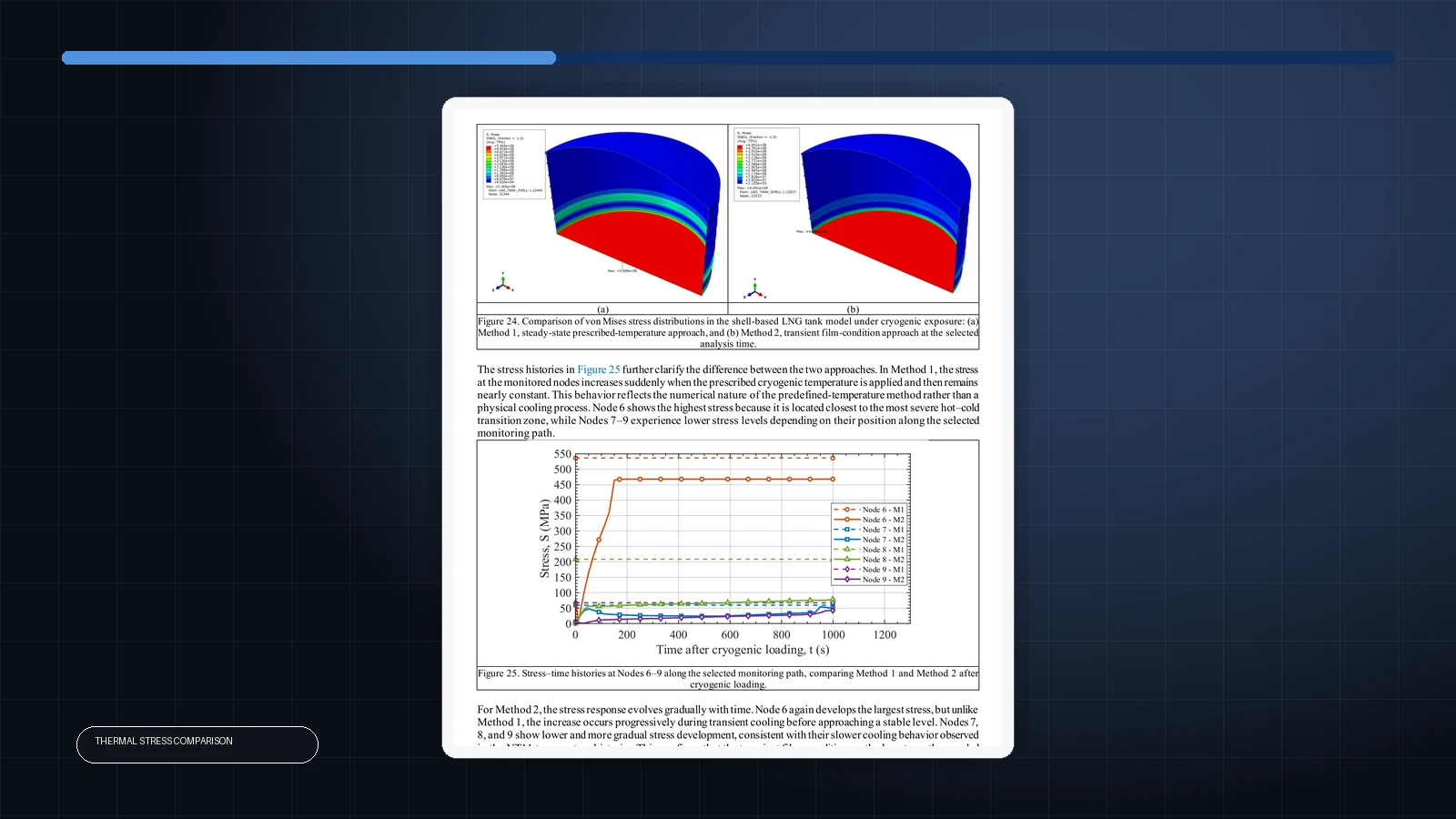
Transient thermal–structural assessment showing how cooling history, transition zones, and restraint govern stress localization.
View engineering case →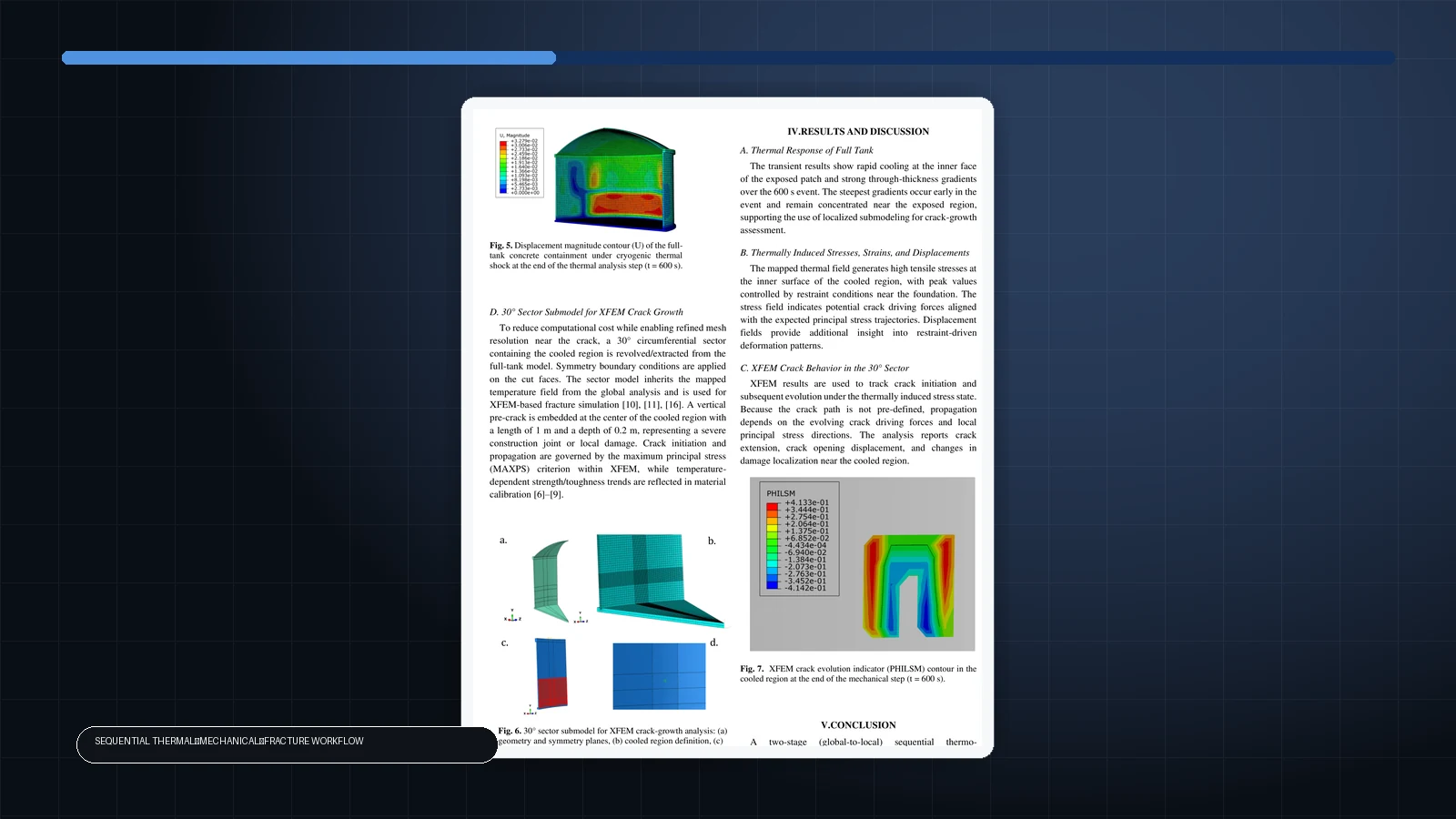
Sequential thermal–mechanical–fracture modelling for pre-cracked containment under localized cryogenic thermal shock.
View engineering case →Ways to engage
Review an existing model, assumptions, loads, materials, contacts, mesh, solver behaviour, and result interpretation.
A clearly bounded engineering question with defined inputs, outputs, and a concise technical deliverable.
Complex nonlinear, extreme-load, thermal, or integrity simulation with verification, sensitivity, and structured reporting.
External specialist capability for engineering teams that need recurring advanced analysis without permanent in-house overhead.
Engineering workflow
Clarify the decision, failure concern, available data, confidentiality, and required deliverable.
Assess geometry, loads, materials, boundaries, uncertainty, and whether advanced simulation is justified.
Select the numerical method and build the model around the governing physics.
Check numerical stability, load paths, mesh, energy, convergence, and sensitivity as appropriate.
Interpret critical response and document assumptions, limitations, conclusions, and next steps.
Technical intake
You do not need to know which solver or modelling method is required. Describe the structure, loading scenario, available data, and the decision you need to make.