Services

Blast, VCE & Impact Simulation

Dynamic simulation support for accidental explosion, vapor-cloud-explosion, impact, and impulsive loading scenarios affecting structures and industrial systems.

Buyer problem

Pressure waves · structural response · vulnerable regions

Accidental explosion or impact loading often governs local failure, support response, flange rotation, or damage progression — and hand methods cannot resolve the local deformation sequence or interaction between components.

Abaqus/ExplicitCEL/ALEblastVCEimpactJWL EOSJH-IICDPJohnson–CookVUMAT
Method
Axis uses Abaqus/Explicit workflows, pressure-time loading, CEL/ALE where appropriate, nonlinear material models, contact definitions, and response-history review to evaluate deformation, damage indicators, critical zones, and comparative mitigation options.
Deliverable
Outputs can include displacement histories, stress/strain demand, plastic strain or damage indicators, pressure/load assumptions, vulnerable-zone maps, retrofit comparison, and a technical report suitable for engineering discussion.
Value
The work helps teams move from a broad hazard scenario to the specific structural regions that require reinforcement, layout review, shielding, inspection, or more detailed assessment.

Typical inputs

What we need to scope this service.

Geometry & boundaries

Drawings, CAD, sketches, support conditions, constraints and known simplifications.

Materials & loading

Material grade, available test data, load history, temperature, pressure, blast/VCE or operating assumptions.

Decision objective

What the simulation must answer: local stress, damage indicator, comparison, screening, report or research evidence.

Technical depth

How Axis scopes dynamic response under impulsive loading and explosion-driven vulnerability.

01

When this service is needed

Use this path when accidental explosion, vapor-cloud explosion, impact or pressure-pulse loading may control local failure. The concern may be a bridge element, tank support, flange, pipe transition, equipment support, retrofit layer, blast shield or vulnerable connection zone.

02

Modelling depth

Depending on the question, the work may use pressure-time histories, reflected pressure and drag components, Abaqus/Explicit dynamic response, CEL/ALE modelling for selected blast problems, contact, material damage, local plasticity and post-processing of displacement, reaction, strain and damage histories.

03

Verification controls

The analysis is checked through load timing, impulse consistency, boundary-condition reasonableness, contact stability, energy behavior, time-history outputs, mesh sensitivity around critical zones and comparison against expected structural response mechanisms.

04

Client value

The output helps clients identify vulnerable regions, compare strengthening options, screen local details, understand support or connection demand and translate dynamic response into practical inspection, retrofit or design-decision questions.

Typical inputs

  • Explosion or pressure scenario, standoff and load definition where available
  • Geometry and support conditions
  • Material grade and damage/plasticity assumptions
  • Acceptance concern: deformation, local failure, residual capacity, leakage risk or retrofit comparison
  • Required reporting depth and confidentiality constraints

Scoping note

The level of modelling is selected after reviewing the engineering question, available data, uncertainty and required decision. Axis does not recommend high-complexity simulation when a simpler verified check is more appropriate.

Related proof

Relevant case studies.

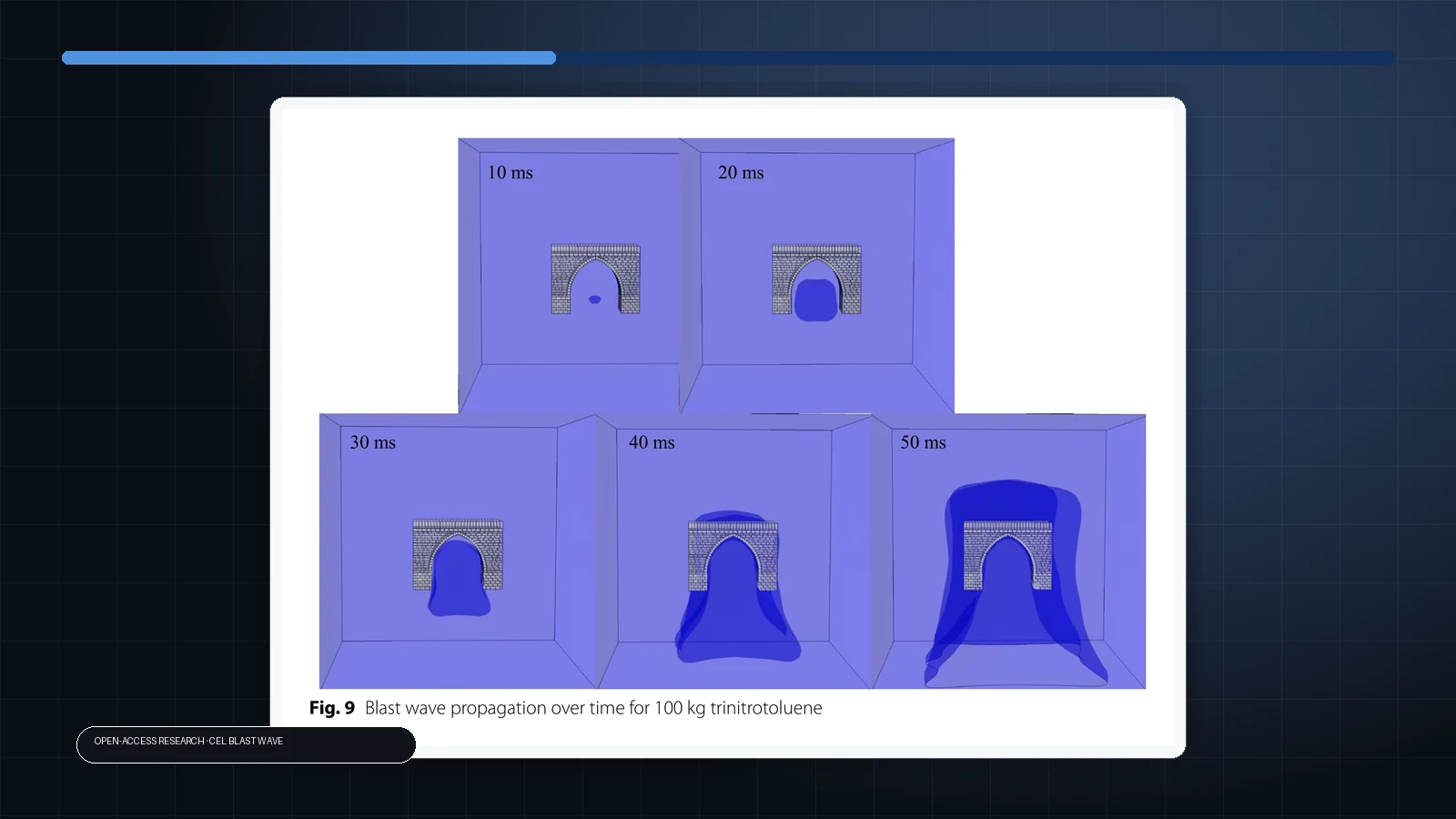
CFRP-strengthened masonry arch bridge under close-range blast visual
Peer-reviewed research case

CFRP-strengthened masonry arch bridge under close-range blast

Peer-reviewed Abaqus/Explicit CEL blast simulation of a CFRP-strengthened masonry arch bridge, with JH-II masonry, Mohr–Coulomb backfill, JWL TNT and VUMAT-based material implementation.

Abaqus/ExplicitCEL blast simulationCFRP strengtheningJH-IIMohr–Coulomb

Read case study →

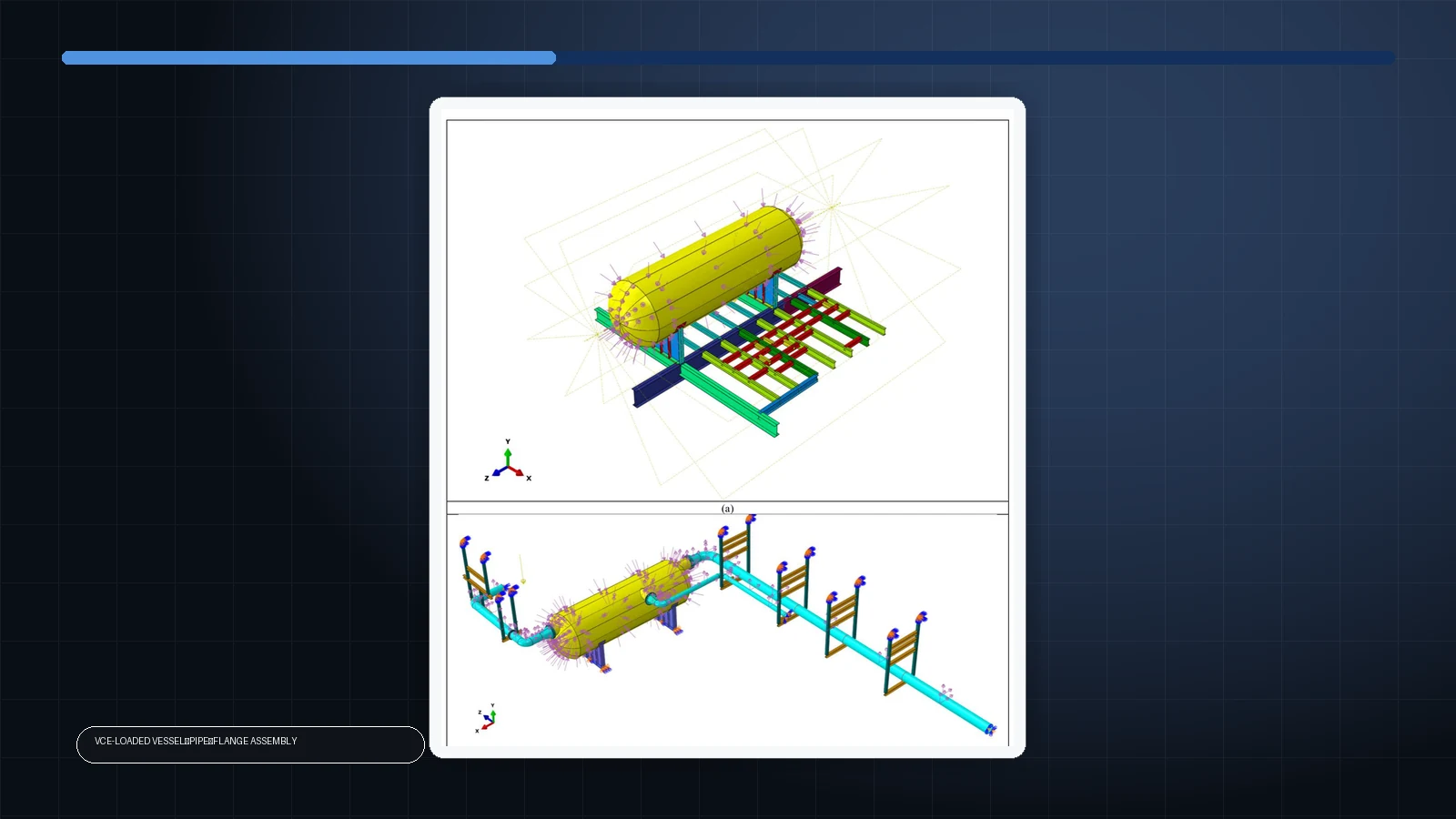
VCE-Driven LNG Vessel–Pipe–Flange Vulnerability visual
Manuscript / internal research development

VCE-Driven LNG Vessel–Pipe–Flange Vulnerability

Nonlinear structural–environmental assessment linking VCE-induced local deformation in a connected LNG vessel–pipe–flange system to credible cryogenic-spill initiation regions.

VCE responseLNG vesselpipe–flange assemblysaddle supportPEEQ screening

Read case study →

Scope a blast, VCE & impact simulation problem.

Send available files and the engineering question. Axis FEA will respond with a suitable analysis route and required inputs.

Request scoping review →