Geometry & boundaries
What is being assessed?
Drawings, CAD, dimensions, supports, interfaces, known constraints and relevant simplifications.
Services
Advanced finite element assessment of bridges, masonry systems and infrastructure under extreme loading, local damage and strengthening or retrofit scenarios.
Buyer problem
Existing infrastructure often combines complex geometry, uncertain materials, nonlinear damage mechanisms and retrofit decisions that cannot be represented credibly by a single global stiffness model.
Typical inputs
Drawings, CAD, dimensions, supports, interfaces, known constraints and relevant simplifications.
Material grade/data, preload or operating state, load history, pressure, temperature, impact/blast scenario or other relevant actions.
Local demand, failure mechanism, comparison, screening, residual response, retrofit effect, integrity concern or report requirement.
Technical depth
Use this service for bridge or infrastructure systems where local damage, material nonlinearity, extreme loading, strengthening concepts or unusual geometry make simplified assessment insufficient.
Modelling may include detailed masonry/concrete behaviour, contact, dynamic response, material damage, CFRP/reinforcement representation, local geometric detail and comparative baseline-versus-retrofit studies.
Mesh sensitivity, material assumptions, load application, boundary conditions, energy/time histories for dynamic problems, and qualitative consistency with expected failure modes are reviewed.
Clients receive comparative evidence showing not only whether response changes, but where and why a strengthening concept alters the failure mechanism.
Related evidence
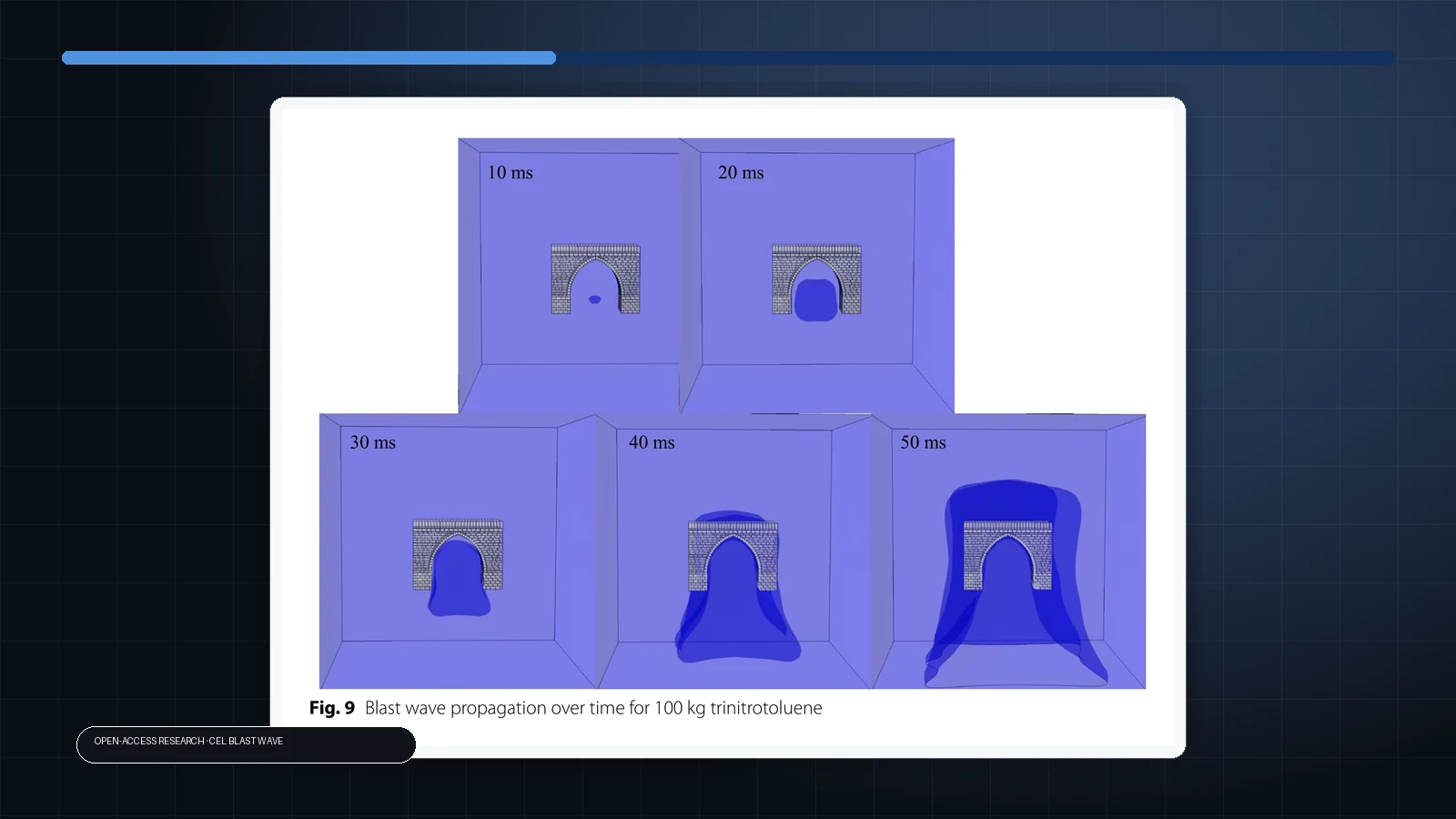
Coupled blast-response simulation and strengthening comparison under severe impulsive loading.
Read case study →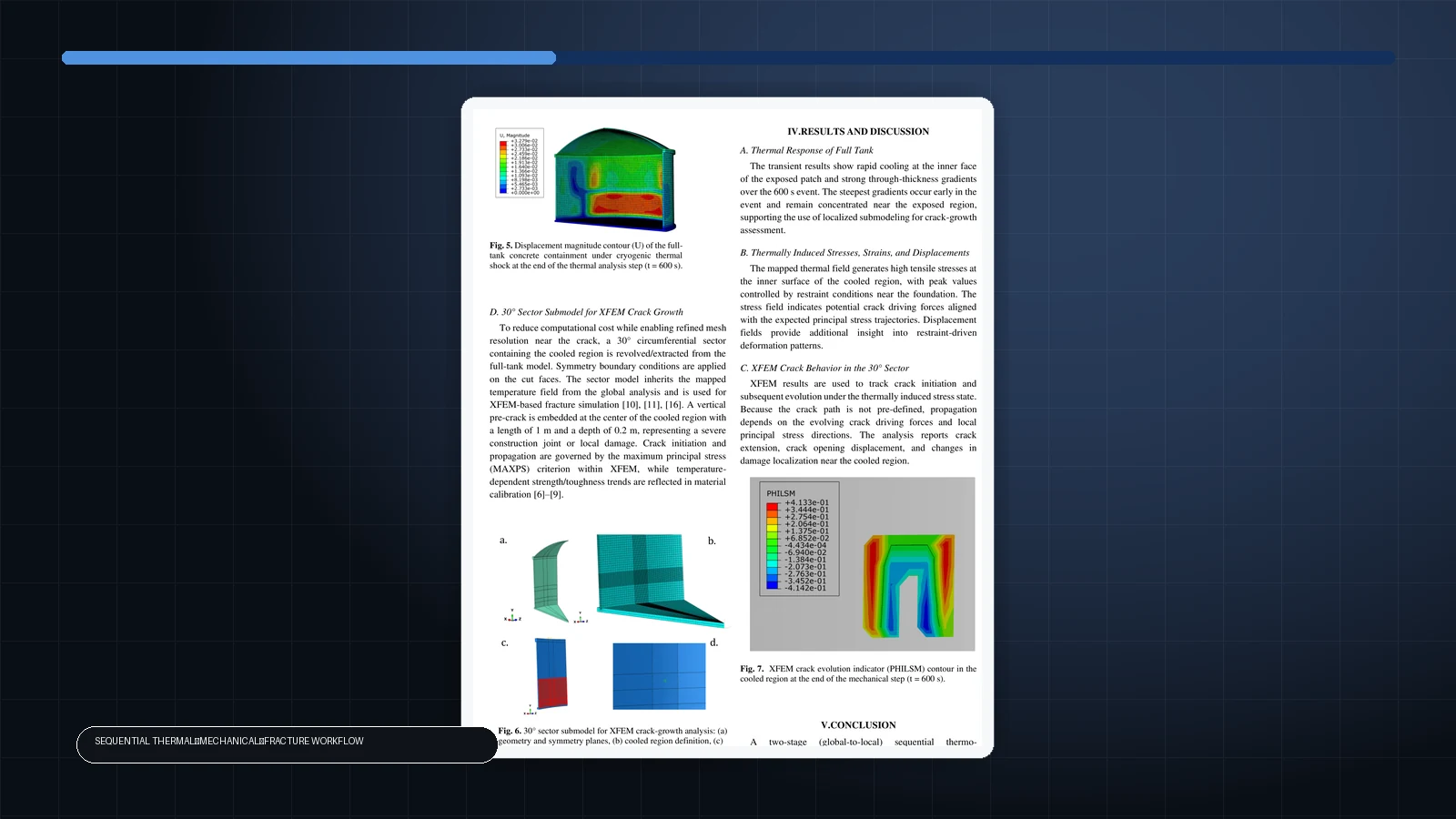
Sequential thermal–mechanical–fracture simulation of pre-cracked containment under cryogenic thermal shock.
Read case study →Send the available information and the engineering question. Axis will propose a suitable analysis route and required inputs.