Engineering problem
LNG blast safety is often treated as a shell response problem, while actual loss-of-containment pathways may initiate at flanges, supports, pipe transitions, saddle regions, or local stiffness discontinuities.
Case Studies
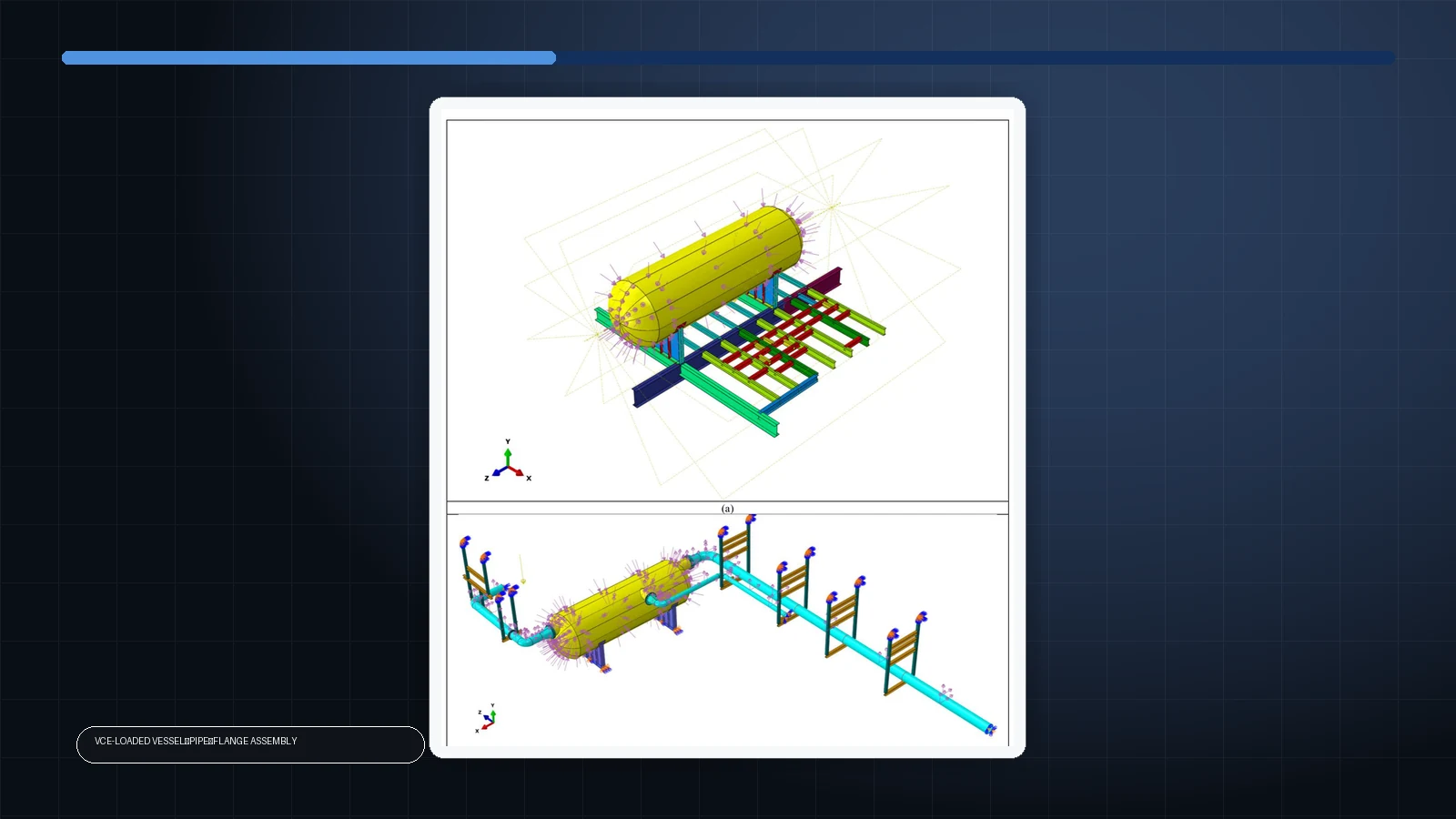
Manuscript/internal research case connecting vapor-cloud-explosion structural response to leakage-prone regions and subsequent cryogenic-spill consequence pathways in a connected LNG vessel system.

LNG blast safety is often treated as a shell response problem, while actual loss-of-containment pathways may initiate at flanges, supports, pipe transitions, saddle regions, or local stiffness discontinuities.
A representative horizontal LNG vessel connected to piping, saddles, flanges and connection details was evaluated under VCE loading. The model considered reflected overpressure, drag loading, gravity, internal pressure, shell–solid discretization, contact interaction, and rate-independent elastic–plastic material behavior.
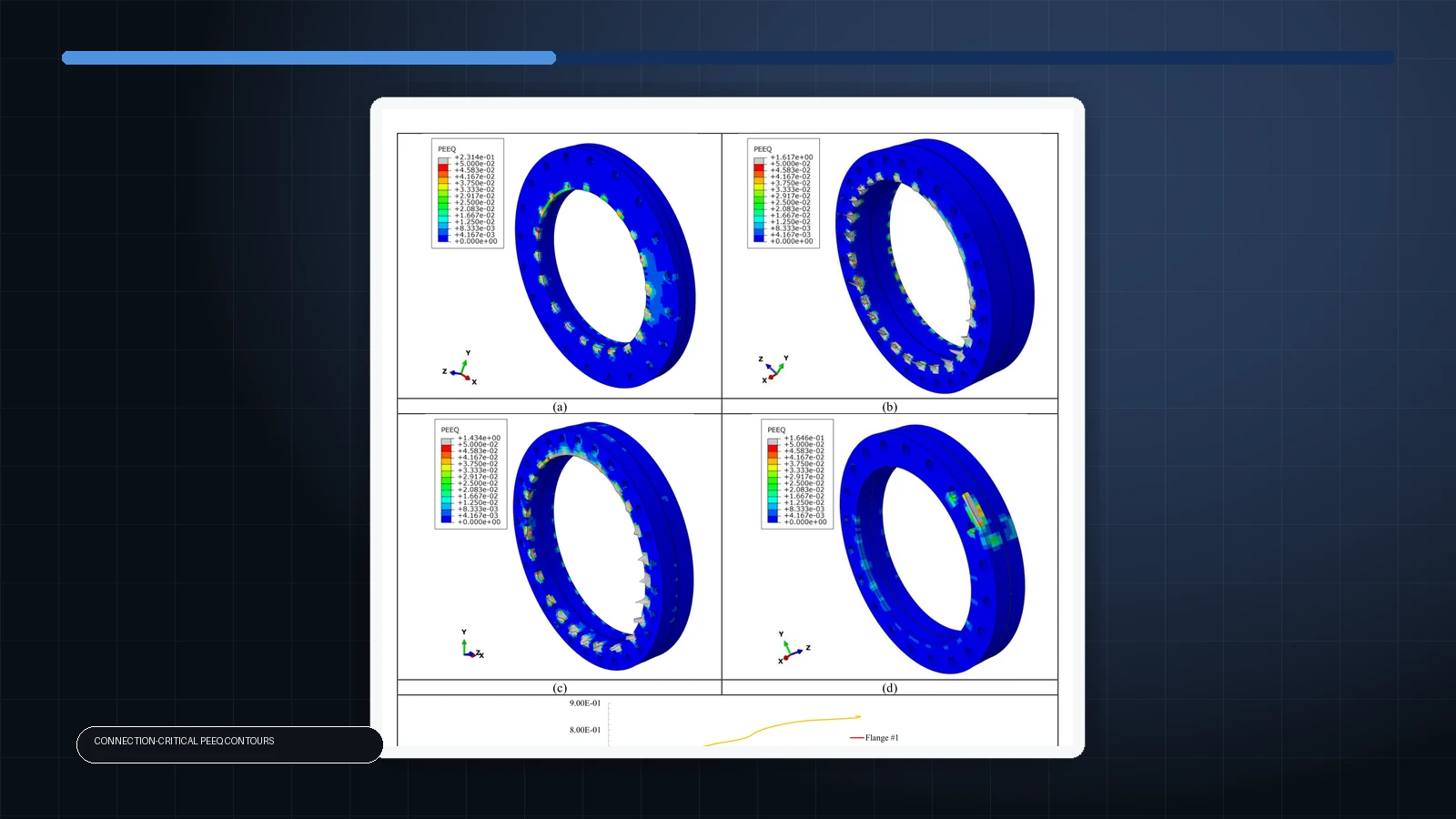
Stress, displacement, reaction force and equivalent plastic strain screening were used to identify connection-critical regions and interpret how local deformation could develop into cryogenic-spill consequence pathways.
The case demonstrates a mechanically conditioned approach to accident assessment: from explosion loading, to local structural deformation, to leakage-prone regions, to spill and vapor-cloud consequence interpretation.
Case-study depth
LNG blast safety is often simplified as a shell-strength question, but real escalation can begin at connection-critical details: flanges, pipe–vessel transitions, saddle supports, local supports and stiffness discontinuities. These details may deform or unload before the main vessel shell reaches a global failure mode.
The study uses nonlinear finite element modelling of a representative horizontal LNG vessel connected to piping, flanges, supports and local details under VCE loading. Reflected pressure, drag, gravity, internal pressure, shell–solid discretization, contact interaction and elastic–plastic material response are treated as part of the system-level problem.
The analysis focuses on displacement, reaction response, stress/strain fields, PEEQ screening and localization of vulnerable regions. Structural hotspots are then interpreted as credible cryogenic-spill initiation zones and linked to pool spreading, vaporization, dense vapor cloud formation and escalation pathways.
For industrial clients, this demonstrates why FEA should not stop at global shell contours. The useful result is the chain from blast demand to local deformation, from local deformation to leakage-prone regions, and from leakage-prone regions to inspection, shielding, reinforcement or emergency-isolation priorities.
Professional caveat
Presented as manuscript/internal research proof. Exact unpublished numerical values, confidential inputs and project-specific conclusions should be controlled until publication or client approval.
Technical interpretation
This case is used on the Axis website as evidence of modelling depth, not as a universal template. Similar client work would be scoped around project-specific geometry, data availability, material calibration, load definition, reporting needs and verification requirements.

Send the engineering question, available data and expected deliverable level for scoping.