Engineering problem
A common cryogenic-spill simplification is to prescribe a low temperature directly to the exposed region. That approach is efficient, but it does not reproduce the time-dependent cooling process governed by boiling heat transfer.
Case Studies
Thesis-linked development case comparing prescribed-temperature and transient film-condition thermal loading for cryogenic spill-induced stress in a shell-based 9% Ni steel LNG tank model.

A common cryogenic-spill simplification is to prescribe a low temperature directly to the exposed region. That approach is efficient, but it does not reproduce the time-dependent cooling process governed by boiling heat transfer.
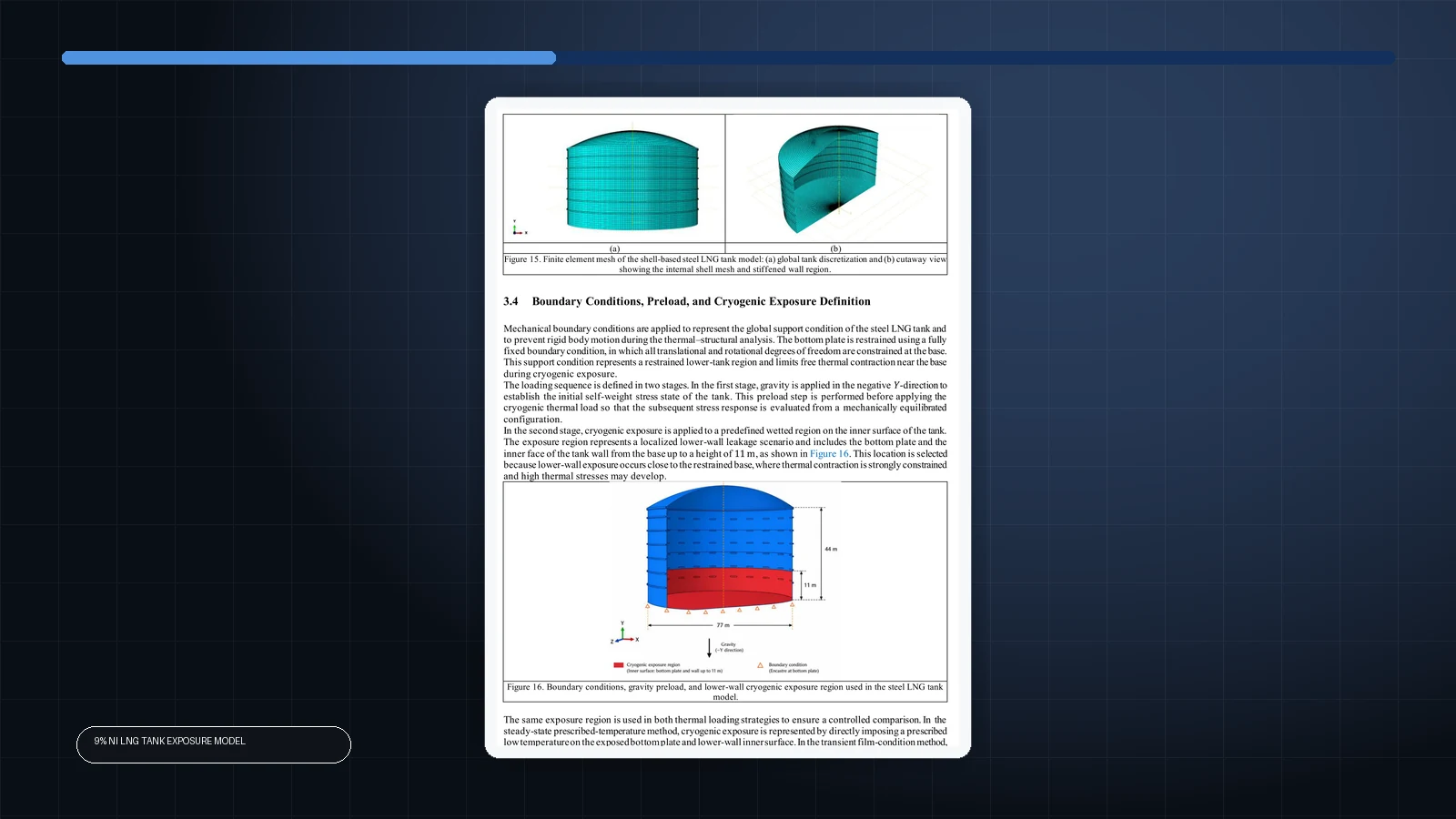
The study compares a steady-state prescribed-temperature method with a transient film-condition method derived from LN₂ boiling heat-transfer behavior. Both methods are applied to the same shell-based 9% Ni LNG tank geometry, material model, mesh, support condition, gravity preload and exposure region.
Temperature histories, shell-surface temperature variation, von Mises stress contours and stress-time histories are compared to show how thermal-boundary formulation changes predicted stress development.
The case demonstrates that the hot–cold transition region can govern thermal stress and that cooling history may be necessary for physically representative LNG tank-shell assessment.
Case-study depth
Cryogenic exposure is often reduced to a prescribed cold temperature, but actual LNG/LN₂ contact produces a time-dependent heat-transfer process controlled by boiling regime, surface temperature, exposure duration and local restraint. Minimum temperature alone does not define the structural demand.
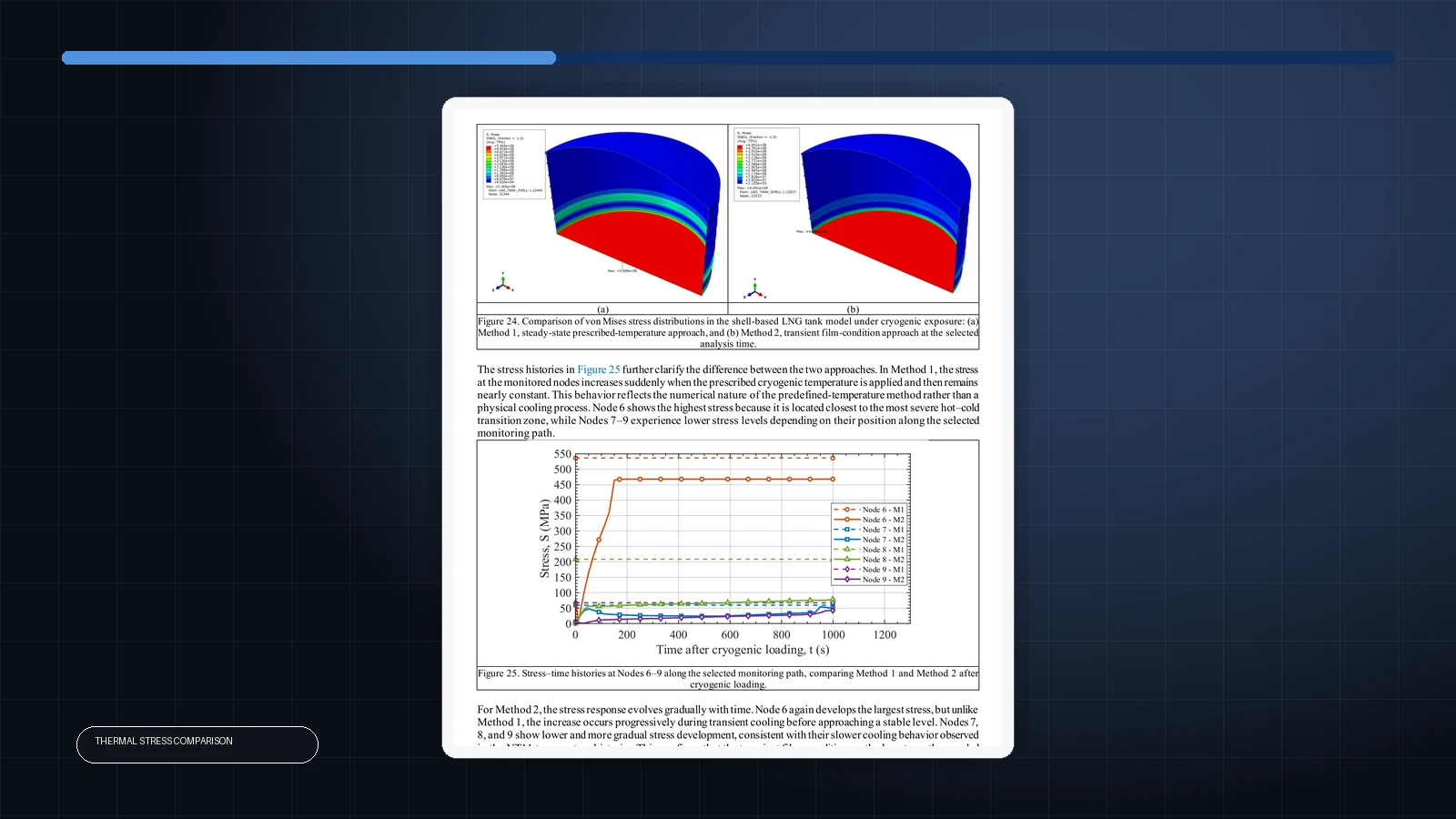
The case compares steady-state prescribed-temperature loading against transient film-condition thermal loading derived from LN₂ boiling heat-transfer behaviour. The resulting temperature histories are used to evaluate progressive cooling, hot–cold transition gradients and time-dependent stress development in the tank shell.
Outputs include temperature-time histories, spatial temperature gradients, von Mises stress contours, stress histories at transition-region nodes and comparison between immediate cold-state response and physically progressive cooling response.
For LNG-related structures, the case demonstrates that thermal boundary formulation is an engineering decision, not a modelling detail. It helps clients understand when a rapid screening method is acceptable and when transient thermal loading is required for a more defensible structural-integrity interpretation.
Professional caveat
The case is thesis-linked development. Fracture, code acceptance and fitness-for-service decisions require material grade, weld/HAZ data, inspection information, toughness data and responsible-engineer review.
Technical interpretation
This case is used on the Axis website as evidence of modelling depth, not as a universal template. Similar client work would be scoped around project-specific geometry, data availability, material calibration, load definition, reporting needs and verification requirements.

Send the engineering question, available data and expected deliverable level for scoping.