Geometry & boundaries
What is being assessed?
Drawings, CAD, dimensions, supports, interfaces, known constraints and relevant simplifications.
Services
Transient heat-transfer and thermo-mechanical simulation for structures and industrial systems where temperature history, thermal gradients, phase-related heat transfer or restraint govern structural response.
Buyer problem
Thermal loading is rarely defined by one temperature value. Exposure history, boundary heat transfer, affected area, duration, material-temperature dependence, restraint and the transition between hot and cold regions can govern the resulting structural demand.
Typical inputs
Drawings, CAD, dimensions, supports, interfaces, known constraints and relevant simplifications.
Material grade/data, preload or operating state, load history, pressure, temperature, impact/blast scenario or other relevant actions.
Local demand, failure mechanism, comparison, screening, residual response, retrofit effect, integrity concern or report requirement.
Technical depth
Use this service when rapid heating/cooling, cryogenic exposure, thermal shock, nonuniform temperature fields or coupled thermal–structural behaviour may govern tanks, shells, supports, piping-related details, concrete containment or other structures.
The modelling depth is matched to available heat-transfer data: from bounded screening cases to transient thermal analysis and mapped thermo-mechanical response. Fracture-oriented follow-on methods can be added where justified.
Thermal boundary assumptions, temperature histories, spatial gradients, mapped-field consistency, temperature-dependent properties, support restraint and stress histories are reviewed.
Clients can understand which part of the thermal scenario drives structural demand and what additional data or follow-on integrity assessment is justified.
Related evidence
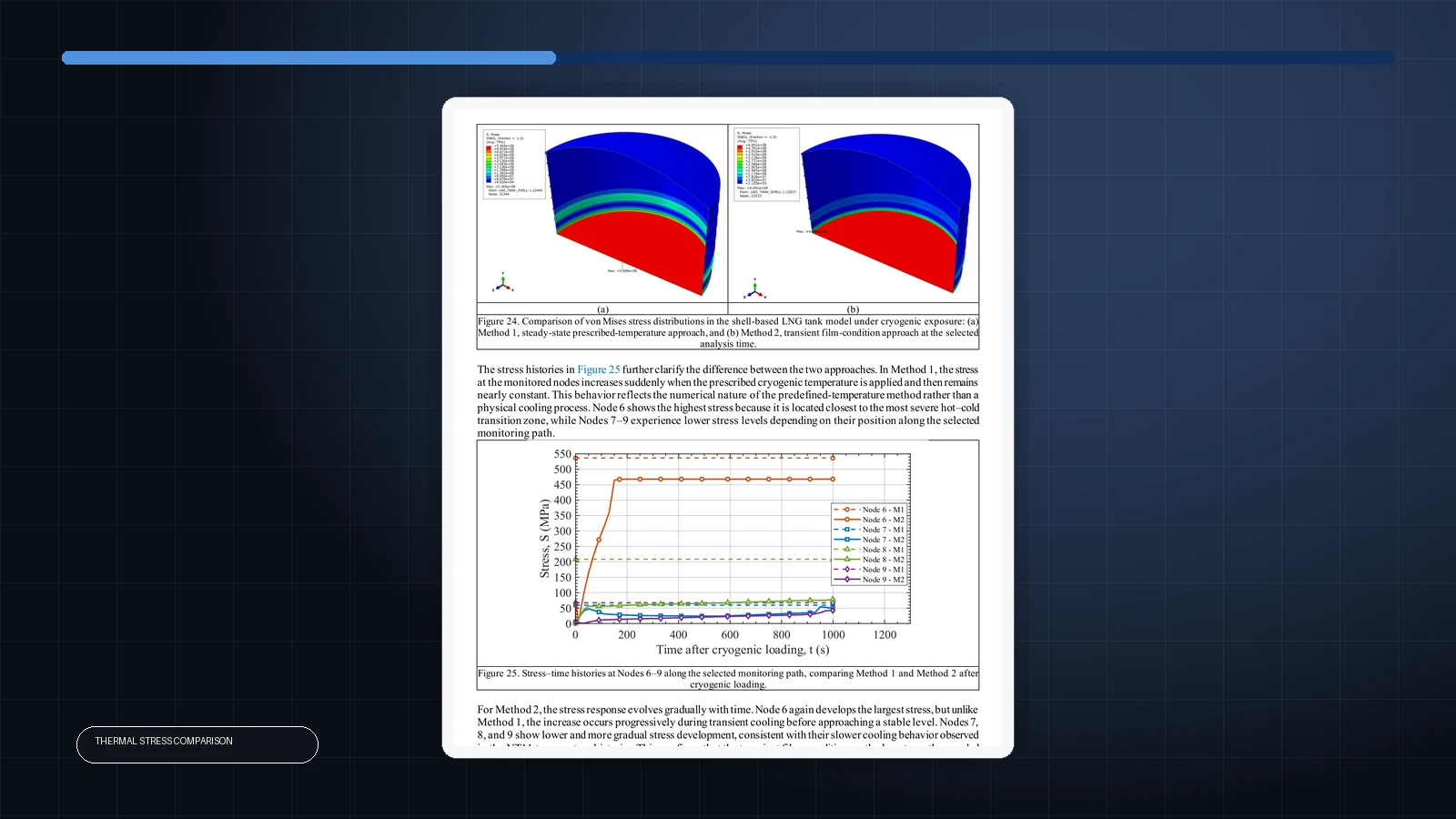
Transient thermal–structural assessment of cooling history, thermal gradients, restraint and stress localization.
Read case study →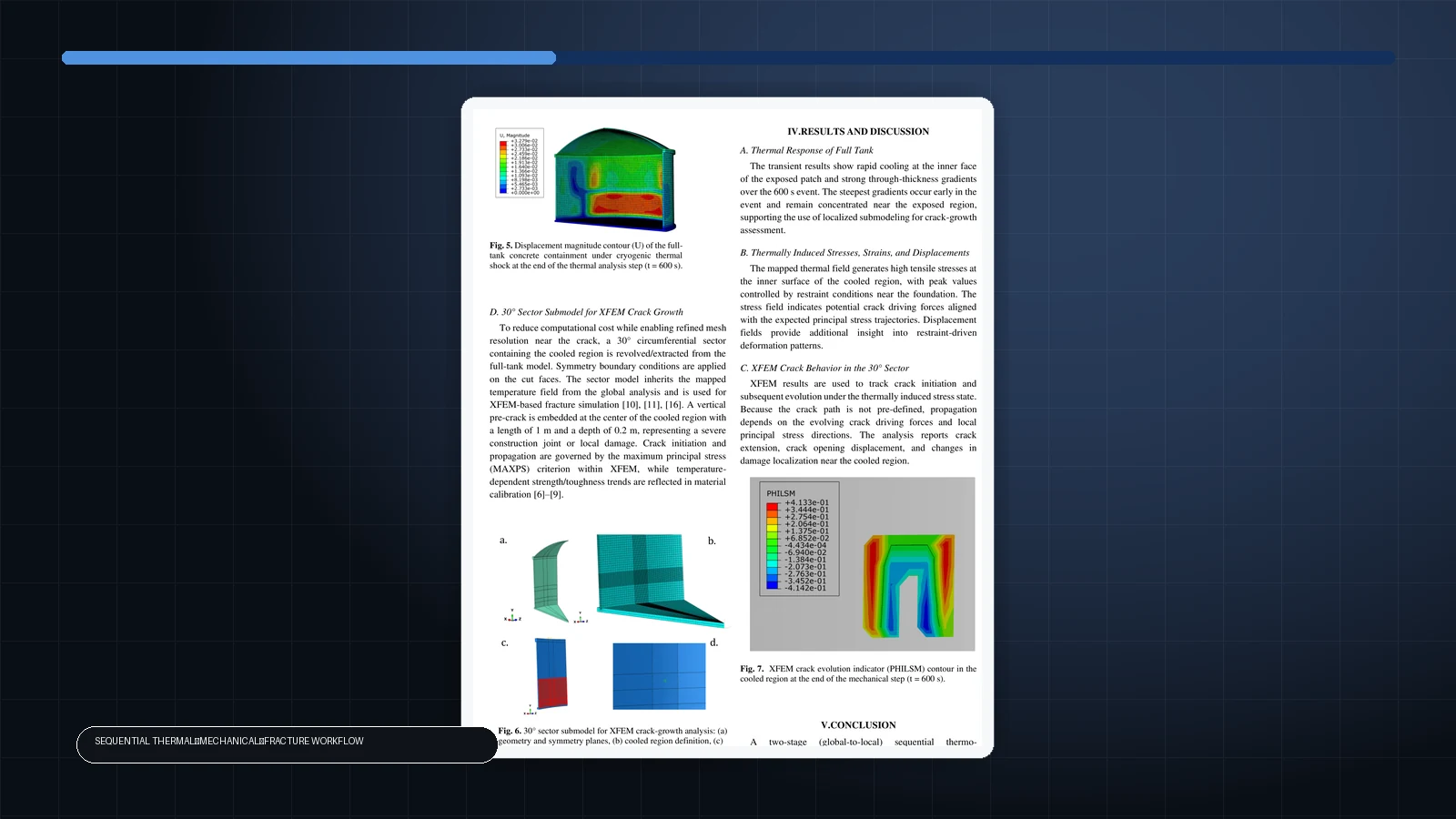
Sequential thermal–mechanical–fracture simulation of pre-cracked containment under cryogenic thermal shock.
Read case study →Send the available information and the engineering question. Axis will propose a suitable analysis route and required inputs.