Case Studies

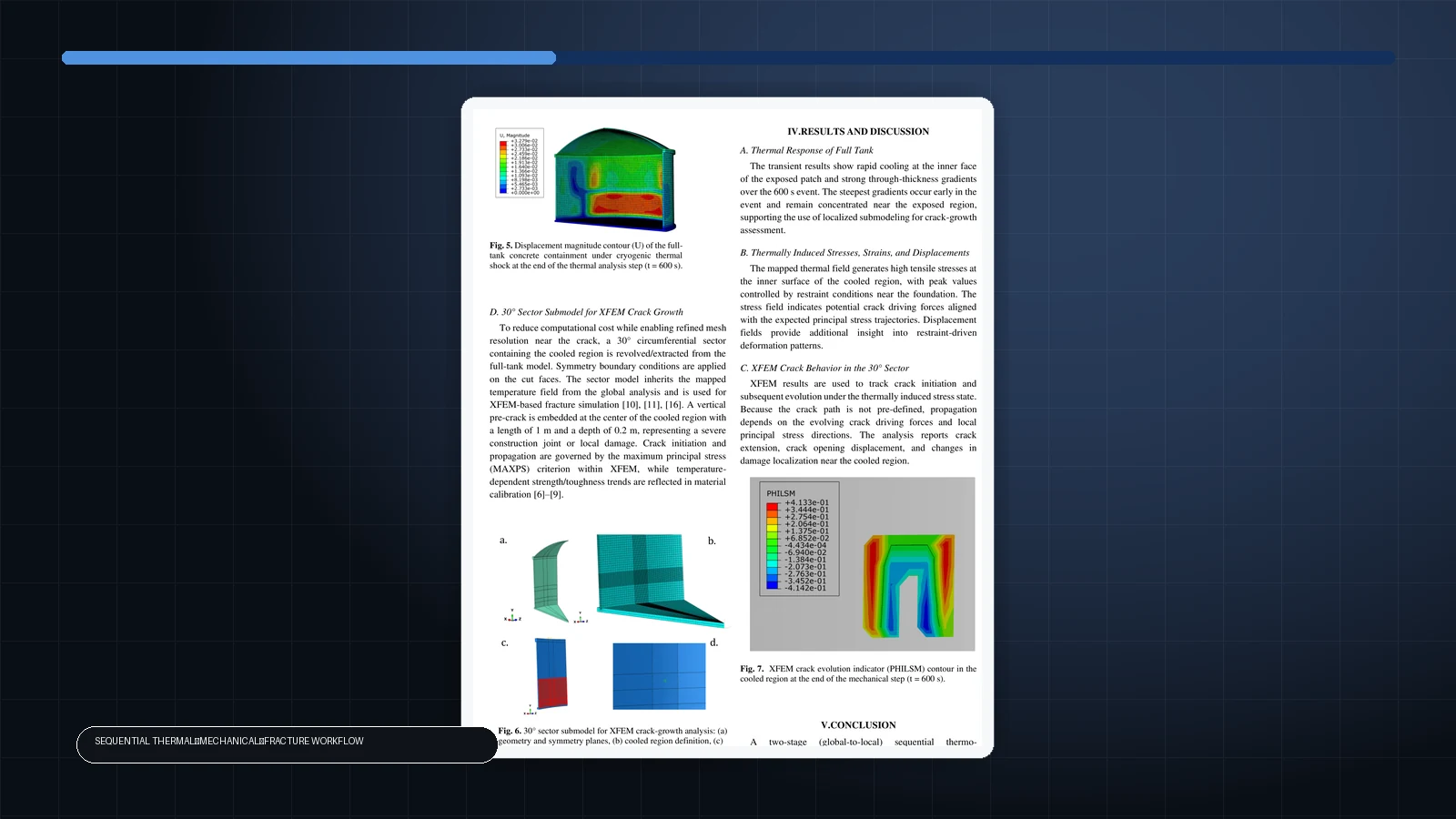
XFEM leak-tightness assessment of LNG concrete containment

Research development case using sequential thermal–mechanical–fracture simulation to evaluate pre-cracked concrete outer containment under localized cryogenic thermal shock.

XFEM leak-tightness assessment of LNG concrete containment main figure
Conference / research development case — figure prepared for website preview.
Status
Conference / research development case
Methods
Abaqus XFEM · thermal shock · concrete containment · global-to-local · 30° sector submodel · crack opening · leak-tightness
Reference
Leak-Tightness-Oriented XFEM Simulation of Cryogenic Spill Thermal Shock on Pre-Cracked Concrete Outer Containments in Full-Containment LNG Tanks
01

Engineering problem

Full-containment LNG tanks rely on an outer reinforced/prestressed concrete wall that must remain structurally sound and leak-tight under credible inner-containment breach scenarios.

02

Modelling approach

A global-to-local Abaqus workflow maps transient heat-transfer results into mechanical analysis and then uses XFEM in a 30° sector submodel to simulate crack initiation and propagation from a pre-existing inner-surface crack.

03

Outputs assessed

Temperature penetration, thermal stress, displacement response, crack depth evolution, crack opening displacement and PHILSM/XFEM crack indicators are evaluated.

04

What it demonstrates

The case demonstrates how cryogenic release physics, thermal gradients, restraint and fracture simulation can be connected for leak-tightness-oriented performance assessment.

Case-study depth

What this case demonstrates.

01

Engineering problem

In full-containment LNG tanks, a severe inner-containment breach can expose the inner face of the concrete outer containment to localized cryogenic cooling. Rapid temperature gradients and restraint-dominated tensile stresses may reactivate existing flaws and threaten leak-tightness.

02

Abaqus approach

The workflow uses a global transient heat-transfer analysis, maps the evolving temperature field into a mechanical analysis and then extracts a local sector/submodel for XFEM crack-growth assessment from a predefined flaw in the cooled region.

03

Outputs assessed

Outputs can include temperature penetration, thermal stress pathways, crack initiation, crack depth evolution, crack opening displacement and local transition from surface cracking toward through-thickness fracture risk.

04

Client relevance

For owners and engineering teams, this case demonstrates a global-to-local route for asking whether localized cryogenic exposure can compromise containment performance. It also shows how mitigation options such as insulation, reinforcement detailing or exposure reduction can be framed for comparison.

Professional caveat

Presented as research development. Real leak-tightness decisions require project-specific concrete properties, reinforcement/prestress details, crack state, exposure conditions and code/owner criteria.

Technical interpretation

How this informs client work.

This case is used on the Axis website as evidence of modelling depth, not as a universal template. Similar client work would be scoped around project-specific geometry, data availability, material calibration, load definition, reporting needs and verification requirements.

Abaqus XFEMthermal shockconcrete containmentglobal-to-local30° sector submodelcrack openingleak-tightness
XFEM leak-tightness assessment of LNG concrete containment secondary figure
Secondary visual selected from prepared case-study assets.
Limitations and caveat. The workflow is a research development case. Final leak-tightness acceptance requires project-specific data, inspection context, material calibration and responsible engineering approval.

Need a similar technical assessment?

Send the engineering question, available data and expected deliverable level for scoping.

Request scoping review →