Geometry & boundaries
Drawings, CAD, sketches, support conditions, constraints and known simplifications.
Services
Local finite element assessment for industrial assets where connection behavior, supports, discontinuities, thermal gradients, or accidental loads control integrity decisions.
Buyer problem
Industrial systems often fail at details: flange faces, bolted joints, nozzles, saddles, pipe transitions, support brackets, and stiffness discontinuities. A shell-only or isolated component model may miss the actual pathway to loss of containment.
Typical inputs
Drawings, CAD, sketches, support conditions, constraints and known simplifications.
Material grade, available test data, load history, temperature, pressure, blast/VCE or operating assumptions.
What the simulation must answer: local stress, damage indicator, comparison, screening, report or research evidence.
Technical depth
Use this path when the integrity question is local rather than global: flange rotation, gasket unloading, nozzle distortion, saddle support reaction, pipe–vessel transition stress, equipment-support demand or local plastic deformation under accidental or operating loads.
Axis can model shell–solid assemblies, tied or contact interfaces, saddle supports, piping branches, flange regions, gravity, internal pressure, thermal or dynamic loading and screening metrics such as stress, strain, PEEQ, displacement, reaction force and history output.
The review focuses on load paths, support reactions, contact choices, mesh quality at discontinuities, shell-to-solid compatibility, stress/strain localization and whether the chosen screening metric is appropriate for the stated decision.
The result helps clients decide where reinforcement, inspection, blast shielding, layout change, leakage review or more detailed assessment should be prioritized before spending effort on the wrong part of the system.
Typical inputs
Scoping note
The level of modelling is selected after reviewing the engineering question, available data, uncertainty and required decision. Axis does not recommend high-complexity simulation when a simpler verified check is more appropriate.
Related proof
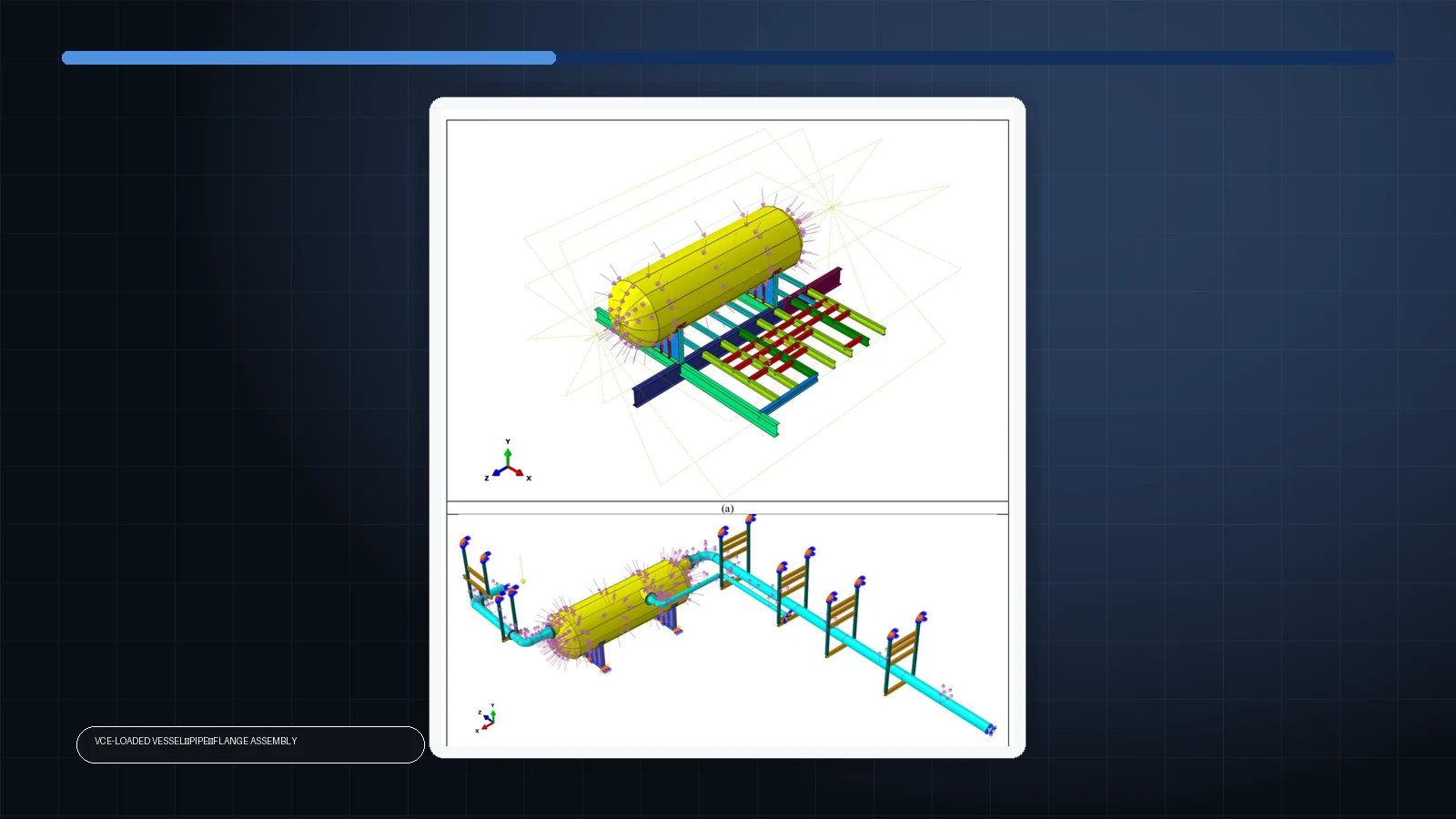
Nonlinear structural–environmental assessment linking VCE-induced local deformation in a connected LNG vessel–pipe–flange system to credible cryogenic-spill initiation regions.
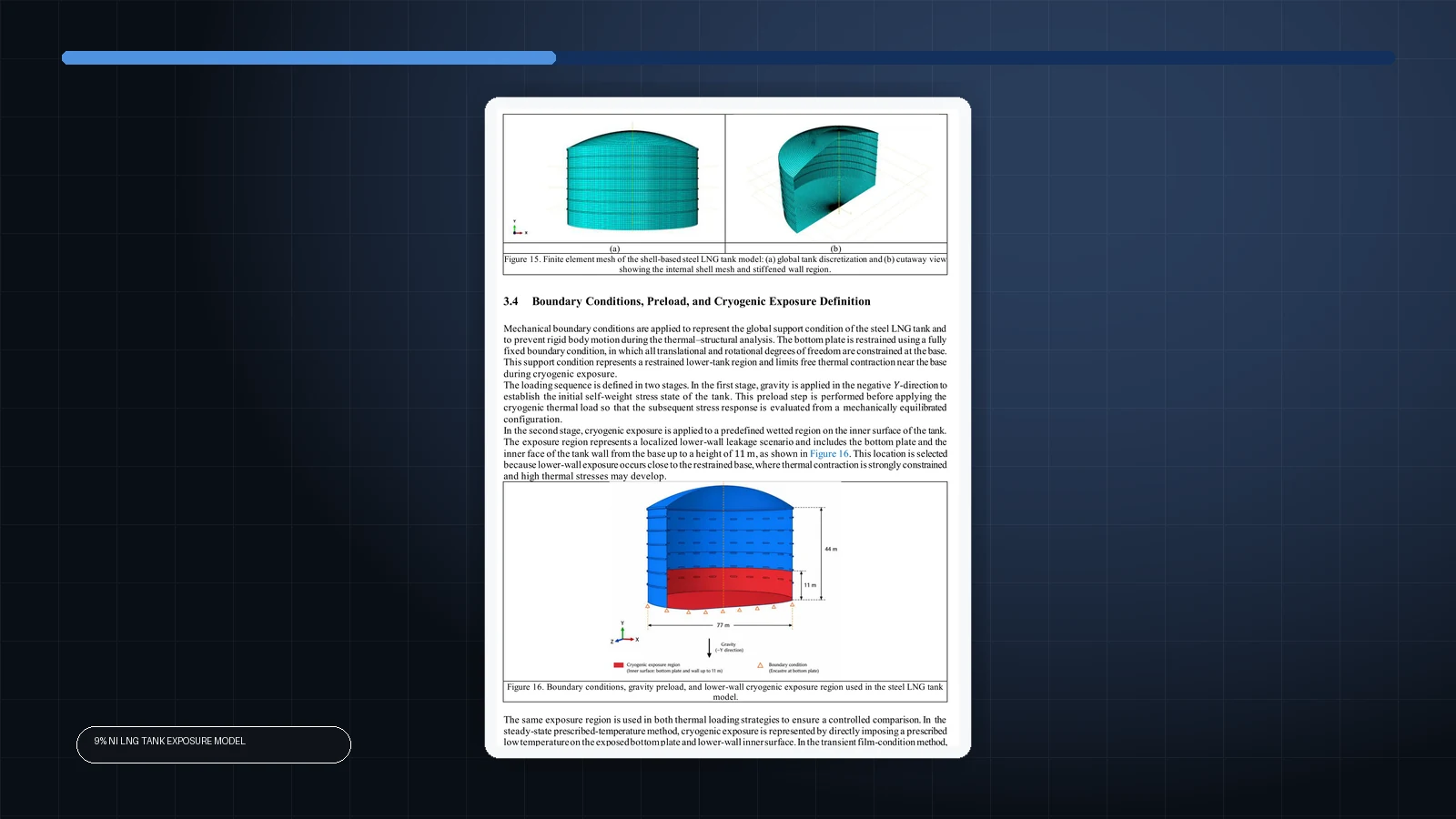
Finite element comparison of prescribed-temperature and transient film-condition thermal loading for cryogenic spill-induced stress in a shell-based 9% Ni steel LNG tank.
Send available files and the engineering question. Axis FEA will respond with a suitable analysis route and required inputs.