Geometry & boundaries
Drawings, CAD, sketches, support conditions, constraints and known simplifications.
Services
Simulation of cryogenic spill, low-temperature exposure, transient heat transfer, thermal stress, and integrity-relevant response in LNG/LN₂ containment and support systems.
Buyer problem
Cryogenic exposure is not simply a low-temperature value. The response depends on wetting, boiling regime, heat-flux history, exposure duration, affected area, local restraint, material grade, weld/detail sensitivity, and the transition between cooled and warmer regions.
Typical inputs
Drawings, CAD, sketches, support conditions, constraints and known simplifications.
Material grade, available test data, load history, temperature, pressure, blast/VCE or operating assumptions.
What the simulation must answer: local stress, damage indicator, comparison, screening, report or research evidence.
Technical depth
Use this path when LNG, LN₂ or another cryogenic exposure can create rapid local cooling, thermal gradients, restrained contraction or transition-region stress concentration in tanks, shells, supports, piping, flanges, concrete containments or adjacent structural details.
The work can include prescribed-temperature screening, transient heat-transfer analysis, film-condition boundaries derived from boiling heat-transfer data, sequential thermal-to-structural mapping, thermal stress assessment and interpretation of vulnerable regions near supports, discontinuities and hot–cold transition zones.
Axis checks thermal boundary assumptions, exposure region definition, temperature histories, spatial gradients, mapped-field consistency, material-temperature definitions, support restraint and stress-history response. Cryogenic interpretation is never based on minimum temperature alone.
This service helps teams understand whether the thermal loading formulation is physically reasonable, where stress concentrations develop, which details deserve further fracture or integrity review and what additional data are needed for a code-level or owner-level decision.
Typical inputs
Scoping note
The level of modelling is selected after reviewing the engineering question, available data, uncertainty and required decision. Axis does not recommend high-complexity simulation when a simpler verified check is more appropriate.
Related proof
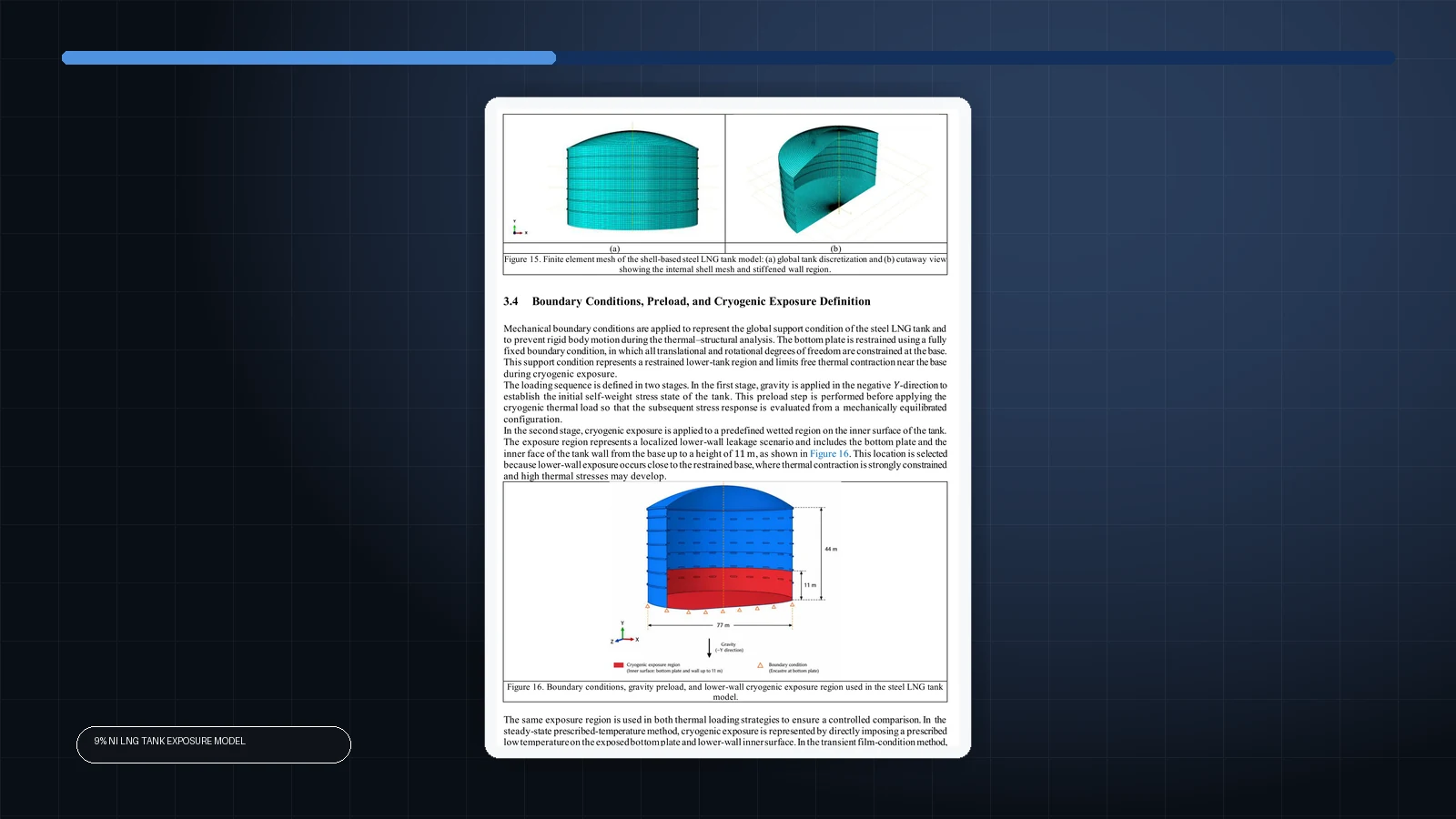
Finite element comparison of prescribed-temperature and transient film-condition thermal loading for cryogenic spill-induced stress in a shell-based 9% Ni steel LNG tank.
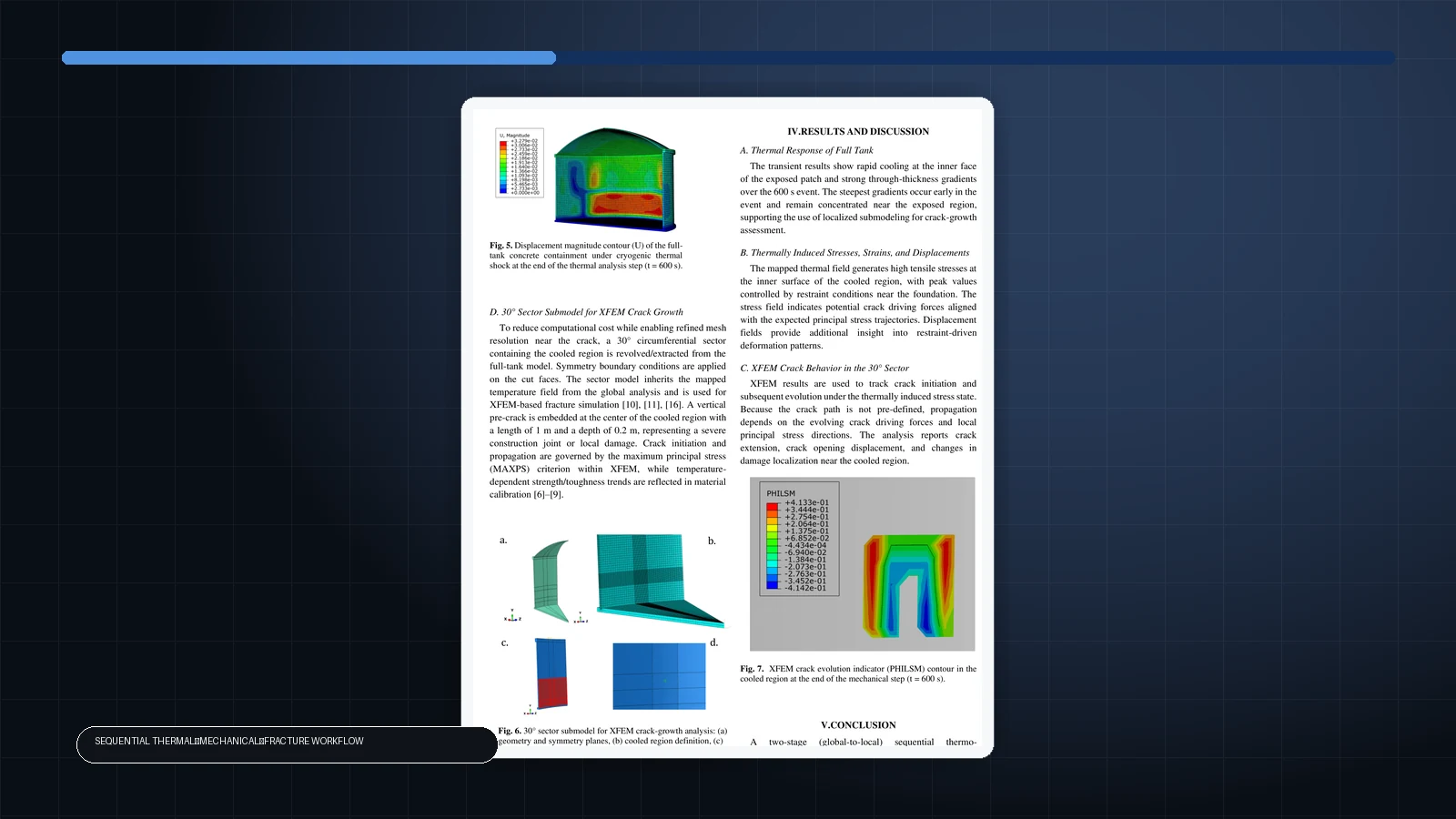
Sequential thermal–mechanical–fracture workflow for pre-cracked concrete outer containment under localized cryogenic spill thermal shock.
Send available files and the engineering question. Axis FEA will respond with a suitable analysis route and required inputs.