Geometry & boundaries
Drawings, CAD, sketches, support conditions, constraints and known simplifications.
Services
Advanced numerical modelling for masonry bridges, arch structures, retrofit concepts, blast response, seismic vulnerability, and damage-mechanism interpretation.
Buyer problem
Historic and masonry bridges can have complex geometry, discontinuous materials, low tensile capacity, local cracking, spalling, and brittle damage mechanisms that simplified global models cannot represent adequately.
Typical inputs
Drawings, CAD, sketches, support conditions, constraints and known simplifications.
Material grade, available test data, load history, temperature, pressure, blast/VCE or operating assumptions.
What the simulation must answer: local stress, damage indicator, comparison, screening, report or research evidence.
Technical depth
Use this path when a bridge or arch structure requires nonlinear assessment under blast, seismic action, retrofit comparison or local damage investigation. It is especially relevant where masonry, backfill, CFRP, steel reinforcement or concrete components interact in a way that simplified methods cannot resolve.
The service can include geometry idealization from drawings or scans, macro- or micro-modelling, CDP, JH-II, Mohr–Coulomb or other material models, contact/interface decisions, dynamic loading and comparison of strengthened versus unstrengthened configurations.
Axis FEA reviews support assumptions, mesh adequacy, material-model sensitivity, damage localization, displacement histories, energy response and whether the chosen model is proportionate to the decision being made.
The output supports retrofit screening, damage-mechanism understanding, vulnerable-zone identification and communication of results to engineers, owners or researchers who need more than a qualitative statement of risk.
Typical inputs
Scoping note
The level of modelling is selected after reviewing the engineering question, available data, uncertainty and required decision. Axis does not recommend high-complexity simulation when a simpler verified check is more appropriate.
Related proof
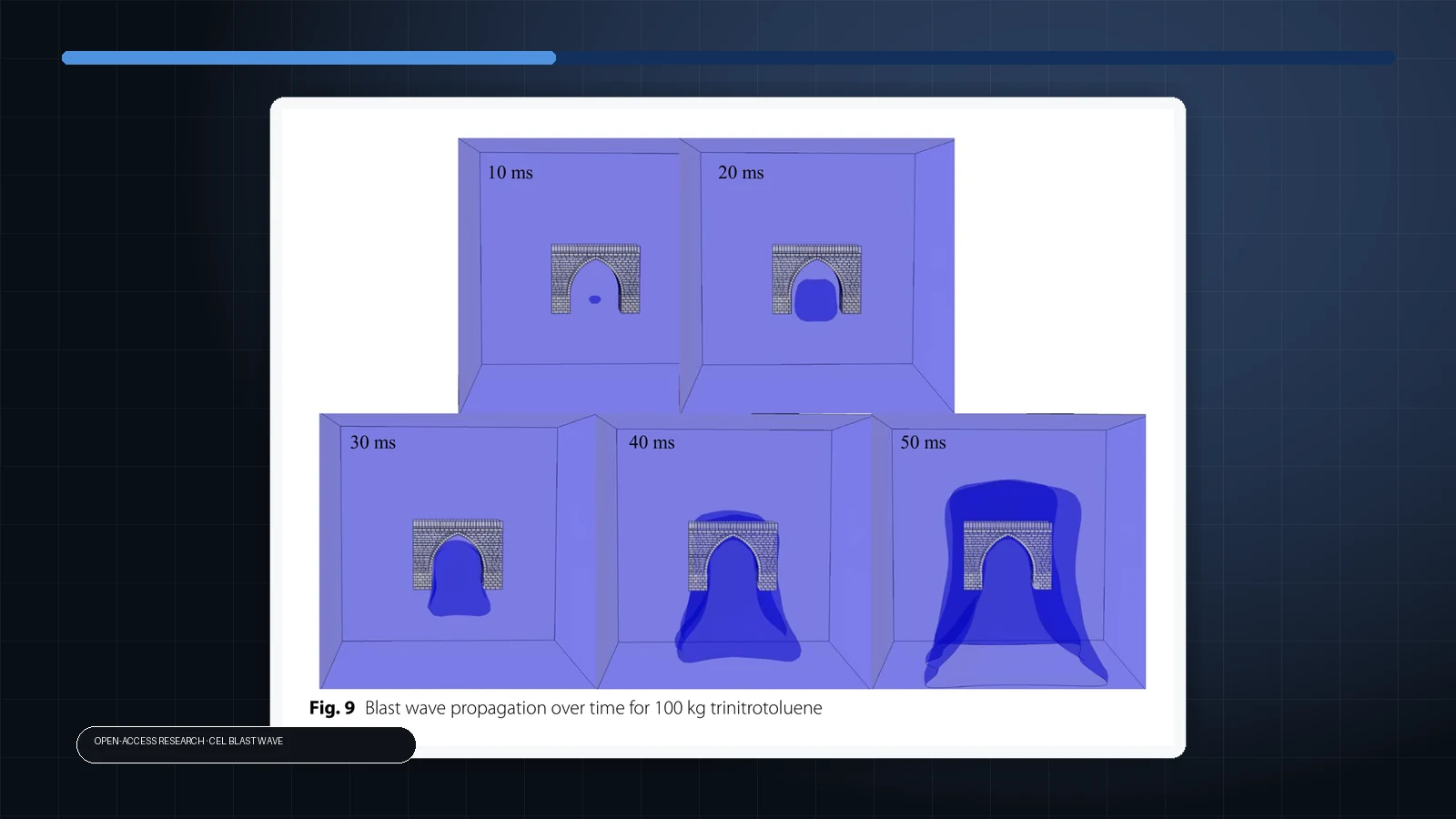
Peer-reviewed Abaqus/Explicit CEL blast simulation of a CFRP-strengthened masonry arch bridge, with JH-II masonry, Mohr–Coulomb backfill, JWL TNT and VUMAT-based material implementation.
Send available files and the engineering question. Axis FEA will respond with a suitable analysis route and required inputs.